By Kristina Moskalenko
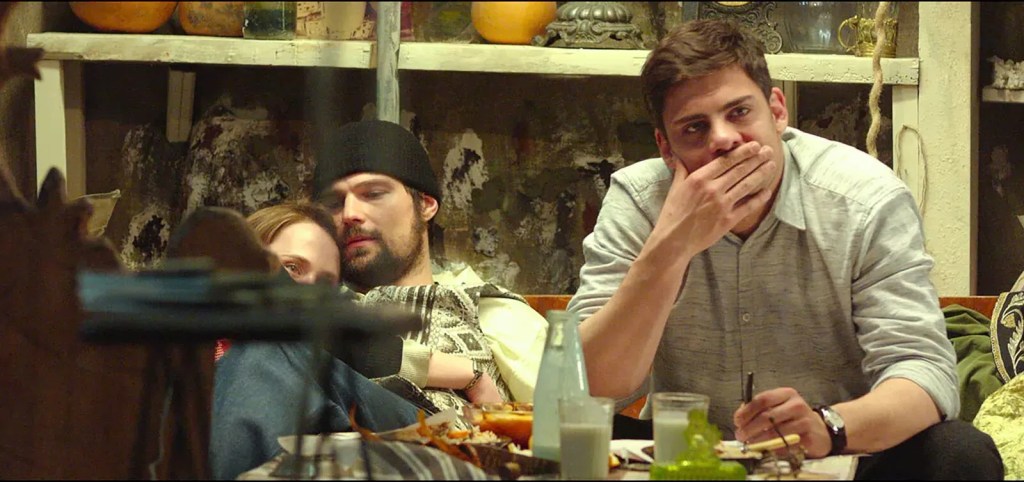
Remarkably, Netflix acquired the rights to Dovlatov, the film by Russian director Alexei German Jr. After all, Baryshnikov is well-known in the West, but Dovlatov? So why did the American giant choose to buy a Russian film that depicts six days in the life of an obscure Soviet writer Sergei Dovlatov, unpublished and largely unknown, an émigré and sharp critic of the regime, capturing his struggles in 1970s Leningrad (now Saint Petersburg) before he emigrated from the Soviet Union to New York?
This is all the more remarkable considering that the only other major contemporary Russian film currently on Netflix is the 2013 war epic Stalingrad by Fyodor Bondarchuk, produced according to all the rules of Hollywood. Dovlatov, by contrast, is simple, heartfelt, and instantly accessible. A film without grand ambitions or philosophical pretensions, built instead on comic situations familiar to anyone who grew up in the USSR: apartment gatherings, trying to navigate one’s path while joining politically useful professional organisations, a mother’s advice, buying gifts amid shortages, and dreams of a better future.
We met with director Alexei German Jr. at the Corinthia Hotel in London during the London Film Festival 2018 to find out how, almost unwittingly, he made the most commercially successful Russian film in the West.
Alexei begins, in his usual direct manner: “I asked for no domestic press, how did you manage to get through?”
Kristina Moskalenko: We are an independent French-owned magazine, writing for Russian-speaking residents and visitors in London, Paris, and the French Riviera. This isn’t exactly the Russian press, although we write in Russian, but we have more breathing space here. That’s how we managed it.
Alexei German Jr.: So, you write for those who are afraid they’ll have something taken away?”
Kristina Moskalenko: Not at all. Many Russian speakers who emigrated, have started businesses, built lives outside Russia, and depend on no one. Let’s not get paranoid or stuck in stereotypes, it’s 2018. Let’s have a drink instead.
Alexei German Jr.: Like Misha Zelman (*Mikhail Zelman, owner and founder of the international chain of Burger & Lobster mono-restaurans, London Goodman steakhouses, Zelman Meats), I see…
Kristina Moskalenko: Yes, there are plenty of Russian speakers in London who aren’t particularly nostalgic for the USSR or deeply attached to modern Russia. And here’s a compliment: your film Dovlatov is perfectly understandable even to someone who never lived in the USSR, or barely did. It even hits emotionally… And yet it avoids the usual tropes about oppression and repression that Western audiences often expect. I’d say the film captures enough of the Russian spirit, and the atmosphere doesn’t feel fake. It’s a great film about the USSR for people who never lived there. Was that intentional?
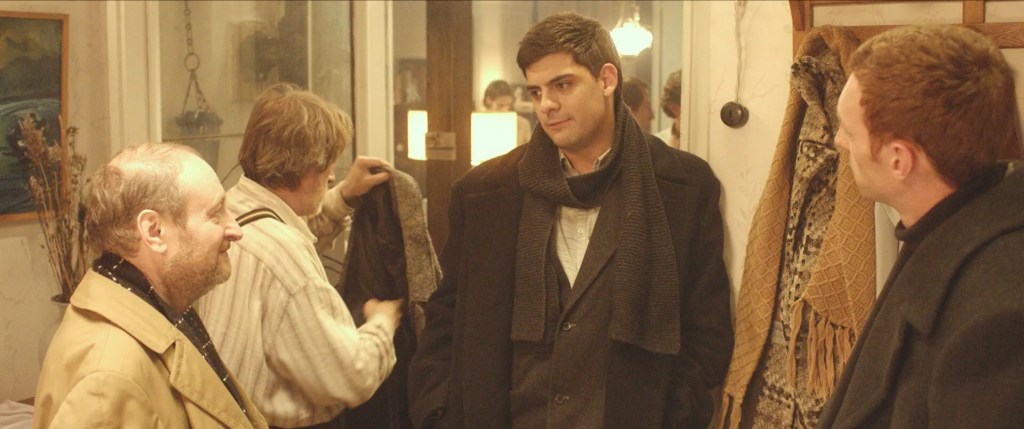
Alexei German Jr.: That was never the goal. The reality is that generations change, perceptions change, and a huge layer of understanding and knowledge disappears. So, unfortunately, some things have to be adapted and explained, because that reality is gone. The same goes for foreigners, who often have no knowledge at all about that period in the USSR.
Kristina Moskalenko: Do foreigners know Dovlatov?
Alexei German Jr.: No, of course not, nobody knows anything.
Kristina Moskalenko: How did you manage to get it on Netflix then?
Alexei German Jr.: I don’t know. We didn’t manage anything, Netflix approached us themselves. They saw that the film did well in Berlin, Dovlatov was in the main competition at the 68th Berlin International Film Festival, where production designer Elena Okopnaya won the Silver Bear for Outstanding Artistic Contribution, and the film also received the Independent Jury Prize from the Berliner Morgenpost. They saw the good reviews, the audience reaction. We didn’t pitch it to anyone or push it on anyone. Moreover, we never made the film with the West in mind, unlike some Russian films that are consciously crafted to cater to a simplified perception of our dear homeland.
Kristina MoskalenkoL: You mean those films about the hardships and atrocities of life in Russia, that English-speaking critics call chernukha?
Alexei German Jr.: I don’t know if it’s chernukha or not, but they love it. Honestly, I don’t care if Western audiences understand our film, this has never been on my list. In fact, I never wanted to go to England. I don’t like London! I find it boring; I prefer Italy.
Kristina Moskalenko: Well, the food is definitely more fun in Italy!
Alexei German Jr.: Exactly! The fact that Netflix can bring the film to so many countries on every continent proves one thing: if you make a film sincerely, it works. If it’s good, it sort of programs itself. Meanwhile, in Russia, some people hate the film, some love it, and yet it seems to promote itself on its own.
Kristina Moskalenko: Many critics have compared your work to that of your father, especially his film My Friend Ivan Lapshin. Beyond your father, who has influenced you? Kira Muratova? Tarkovsky?”
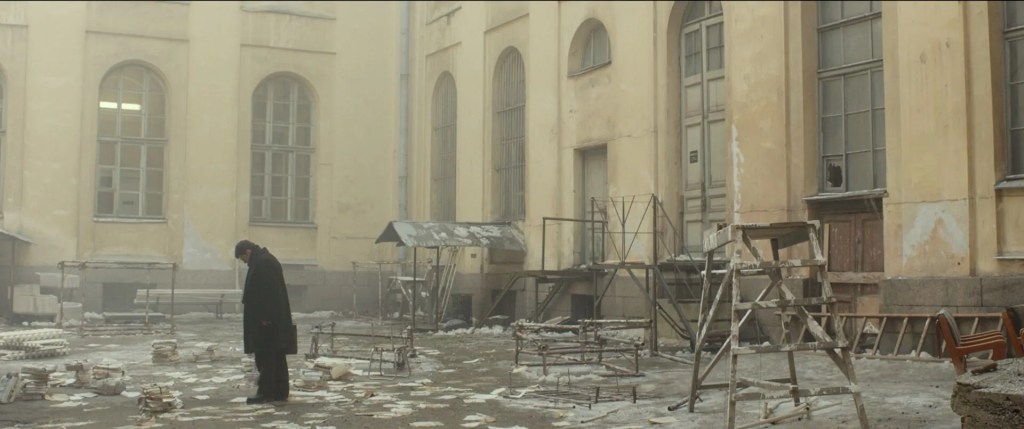
Alexei German Jr.: Plus Fellini, plus Antonioni, and to some extent the Americans. But I don’t take anything from anyone. I just watch, and a feeling emerges: this is correct, and this is not. I don’t watch contemporary cinema; I mostly read or watch people who are already dead. I don’t like the living, they annoy me. But I do watch some good directors, like Dezsö Magyar or the Coen brothers. I would say that I capture some of their their intonations over time, but I’m not deliberately borrowing techniques.
Kristina Moskalenko: And which deceased directors do you watch? Who are your favourites?
Alexei German Jr.: Yasujiro Ozu, Akira Kurosawa, Theo Angelopoulos, Federico Fellini, Ingmar Bergman, and so on.
Kristina Moskalenko: When a director makes a film inspired by a famous person’s life, but not based on verified facts and is more of an interpretation, these interpretations often become accepted as biographical truth over time. Does the director bear any responsibility for this confusion?
Alexei German Jr.: I never took that risk. I knew from the start that our interpretation would contradict the dull, uneducated, kitchen-table perception of Dovlatov. People know a lot about him, but not accurately. So the way we built the character from the beginning is differed from how he exists in popular imagination, where he’s always the charming, slightly drunk womaniser who constantly gets into scrapes. Dovlatov wasn’t quite like that. There’s a difference between a man who gets up at seven in the morning and writes stories using only certain letters, and a man whose life unfolds in random inebriation. But because he himself created and described himself as a lyrical hero, that fictional version replaced him. Over time, the film will inevitably influence how people perceive Dovlatov, but I never made the film with the audience in mind. I’ll say something strange: I didn’t care about the audience at all in this film. And that, precisely, is why Dovlatov became the most commercially successful Russian festival film in the history of domestic cinema.
Kristina Moskalenko: So, after the real and lyrical hero Dovlatov, you have created a third Dovlatov?
Alexei German Jr.: I did it the way I saw it. I didn’t care about anyone else. I believe that’s the only way to work.
Kristina Moskalenko: How did the auditions and casting for the lead role go?
Alexei German Jr.: They took a long time. Ivan Urgant had strong auditions, and Maksim Vitorgan kept coming up. But when Serbian actor Milan Marić arrived, it became clear that we probably needed a foreigner. Because he looked like an epic man and had a charm that can’t be faked.
Kristina Moskalenko: Is that charm from his personality, or from being a foreigner?
Alexei German Jr.: It’s purely his charm. He’s not exactly a theatrical actor, but it’s there in him. It also became obvious that we needed an unknown actor.
Kristina Moskalenko: You’ve said that audience opinion didn’t matter to you. Indeed, viewers’ tastes can often be quite banal. But what about the banality of Dovlatov himself?
Alexei German Jr.: I don’t see any banality in Dovlatov. His generation had far less of it. There was a time, strangely enough, whether we like it or not, of real, powerful, structured literature that tried to answer questions about itself and the country. Writers weren’t obsessed with money; they did what they did because they couldn’t do otherwise, not to become famous or make money. Not like the petty mediocrity of some modern writers, who make money on criticising others, including Dovlatov.
Kristina Moskalenko: But criticising is always easier. And often so much more fun! In Dovlatov there’s a line: ‘These days, writers with a little literary talent are in fashion.’ Don’t you think this applies to all fields now: it’s more advantageous to be moderately talented than truly gifted?
Alexei German Jr.: Absolutely. It’s always been that way, but back then, I think it was still considered good to be genuinely talented. Nowadays, it’s better to fit a format.
Kristina Moskalenko: “Back then”, you mean… when? And where?
Alexei German Jr.: In Russia! Honestly, American and European cinema today is more interesting than Russian cinema. Russian cinema has been greatly exaggerated. If it were really that good, everyone would know about it. As it stands, no one knows much about it, except for four or five directors. In its current form, it’s a parody of Soviet cinema, which was far stronger, more diverse, and more compelling. There was the young Kira Muratova, Ilya Averbakh, even Stanislav Govorukhin… not to mention Tarkovsky.
Today, the average Russian festival film is no different from a similar film made in a small Eastern European country. Typically, the plot goes like this: characters sit in silence for long stretches, eat, live in a small, poor town, swear, drink, sleep with each other, someone walks around naked, some tragedy occurs and so on. That’s a big problem, as is the absence of any talented Russian films depicting the lives of oligarchs and other affluent Russians.
Kristina Moskalenko: Interesting topic!
Alexei German Jr.: There isn’t a single talented film about what big Russian business is really like, how that sky-high life is and feels. There are parodies, where miserable, impoverished people try to depict the lives of the wealthy. Watching these films is both painfully sad and hilariously funny. I have an indicator. A vase of fruit. When I see a vase of fruit on a table belonging to some hostile oligarch (all oligarchs are hostile now, of course), I just see how it comes from the Soviet childhood of the filmmakers. It’s an admiration of tangerines and pineapples!
From this come two problems: Russian poverty is shown primitively, while Russian wealth is either invisible or portrayed as a pathetic parody. At one point, I wanted to make a film about a Russian billionaire, a kind of Citizen Kane: football teams without funding, defence contracts, problems with banks, officials, spies watching from every angle, women, drugs, and so on. We even began developing it, but unfortunately realised that in today’s political and economic climate, such a film is impossible. Because I want to make a real film, not a parody about a large, complex being and its problems.
Kristina Moskalenko: I would add that not only is there no film about wealthy Russia, but Russian ‘rich’ aesthetics are almost nonexistent too. Where is the modern Russian Fabergé? Where are masters on the level of René Lalique or Chanel? In Russia, it’s still either baroque and string quartets, or foreign brands. Even the word ‘glamour’. In the West, it’s a neutral, positive term; in Russian, it has a negative connotation. Why?
Alexei German Jr.: Tell oligarchs not to fund their wives and mistresses, who open fashion and perfume businesses for them to make dresses out of bad fabric! There’s no artistic direction! But I can save it all! (Laughs)
Originally published at: https://russianroulette.eu/netflix-dovlatov/
 Articles on film, luxury lifestyle, culture and tech
Leave a comment