
By Kristina Moskalenko for Kommersant, 2016
Through her consultancy Eco-Age and groundbreaking initiatives such as Chopard’s Green Carpet Collection, Firth is proving that ethics and elegance need not be mutually exclusive—transforming the fashion and jewellery industries one gemstone, one garment, and one red-carpet moment at a time.
The easiest way to introduce Livia Firth is to call her the wife of Colin Firth: ever-present on red carpets, quietly celebrating her husband’s triumphs. But to define her solely by her husband’s fame would be to underestimate her. Livia’s own social and professional orbit is arguably even more influential than that of her Oscar-winning spouse.

In 2009, a trip to Bangladesh changed everything. Visiting factories where near-powerless women toiled in appalling conditions for mass-market brands, she was struck by the human cost of fashion. That experience sparked the acclaimed documentary The True Cost of Fashion, a film that exposed the industry’s dark underbelly and forced companies to rethink their practices. As executive producer, Livia has since made it her mission to champion ethical production in every form.
Her main platform is Eco-Age, the consultancy she founded to guide brands toward responsible business: identifying systemic failings, reshaping operations, and prioritising workers’ rights, environmental sustainability, and the legacy left for future generations. Speaking from her London office, Livia detailed Eco-Age’s ambitious projects, including its landmark partnership with luxury jeweller Chopard, a collaboration that fuses style with conscience.
Q: Together with Chopard, you launched the Green Carpet initiative and unveiled a jewellery collection that has been met with widespread acclaim. I understand that Julianne Moore recently joined the project. How did that come about?
Livia Firth: I don’t know any actor who walks the red carpet and thinks, “I’m in my element, look at me.” It’s actually terrifying—millions of cameras, paparazzi, fashion police, and everyone scrutinising every inch of your body. I’ve never met an actor who genuinely enjoys that moment.
So whenever I introduced the idea of a “green collection,” made entirely from ethically sourced materials, people were immediately drawn to it. On the red carpet, you’re going to be wearing a dress and some jewellery anyway—but it’s far more compelling when the jewellery carries a human story. It gives confidence, because you’re not just saying, “I’m wearing Chopard earrings”; you’re telling a story about the challenges in the jewellery industry and how these pieces are part of the solution.
Julianne Moore has always loved Chopard jewellery. When Carolina Scheufele, head of Chopard’s jewellery division and a friend of hers, introduced the concept of the Green Carpet collection, Julianne was thrilled. For her, it’s not just about wearing a dress; it’s about wearing a story. It opens a conversation not only about the brand but about what’s happening in the world.

Q: Are you involved in designing the jewellery for Chopard’s Green Carpet collection?
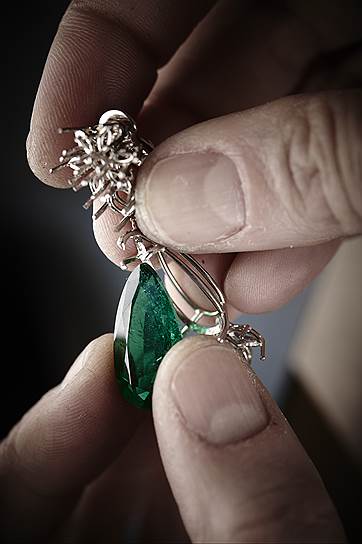
Livia Firth: No, that’s not my specialty. Carolina is an exceptional designer—I’m nowhere near her league. Back in 2012, we took a small bar of certified gold and made a single bracelet. Now we have an entire collection of such pieces, and we’ve also extended the initiative to watches. Today, 70% of the gold Chopard uses comes from certified sources. No one else in the industry is at this level. It’s a strong business case and sets an entirely new standard for the sector—that is what falls under my responsibility.
Q: Which pieces from the collection are your personal favourites?
Livia Firth: I love small, delicate pieces. The Palme Verte earrings, which Carolina created to celebrate the anniversary of the Cannes Palme d’Or, are my everyday go-to. For more statement pieces, at Cannes this year for the premiere of Loving, which Colin produced, I wore Chopard earrings set with large sapphires. They were stunning.
Q: How did your collaboration with Chopard begin?
Livia Firth: It started in 2011, when my husband Colin Firth won his Oscar. You know, Chopard is considered lucky at the Oscars—many actors have received the award while wearing their jewellery. After the ceremony, Carolina approached me to discuss the “green” initiative of my company, Eco-Age. It was straightforward—I simply asked, “Where do you source your gold?” She immediately replied, “From UBS bank.” Then she paused and added, “Oh, I see what you mean. I don’t know where my gold comes from. I buy bars from the bank, but where does UBS get its gold?” In truth, even the bank often cannot trace the origins of the metal, as a single bar can contain gold mined in multiple, disparate locations.
Q: Why does this matter?
Livia Firth: Chopard is a family business: all their jewellery is crafted in Geneva, and their watches are made in the mountain town of Fleurier. They know the hands of every jeweller and artisan who creates each piece. For them, it’s not only logical but essential to also recognise the hands of those who mine the gold and diamonds. They understand that all individuals should be valued same no matter if they are physically closer and are more visible or are far away and hiding behind scenes in the mines. From a business perspective, it’s equally critical to know—and control—the entire supply chain.

One of Eco-Age’s key areas of focus is developing solutions for sourcing raw materials in the jewellery sector. That’s why our partnership with Chopard began immediately. We also partnered with ARM (Alliance for Responsible Mining), a South American NGO working with small mining communities in the mountains of Colombia, Peru, Ecuador, and beyond. ARM audits local mines and issues safety and environmental compliance certifications, giving small operations a chance to access major clients like Chopard.
Q: Like “Fair Trade” certification for coffee?
Livia Firth: Absolutely. But Carolina Scheufele didn’t want to create the mere appearance of responsibility. She could have simply purchased certified gold—which is scarce on the market—but instead she chose to support an NGO that helps small mines elevate standards to meet certification requirements.
Since Chopard began working with Eco-Age, much more than gold sourcing has changed. The brand has become a leader in ethical production, teaching suppliers the standards it expects. When a brand of this calibre asks, “How do you mine this? Do you use mercury? What are your wages?”, suppliers take notice—they want to improve to retain a client of this stature. The Green Carpet collection is intended to communicate this behind-the-scenes work and show that the brand itself is evolving.
We started with gold—but soon expanded into coloured gemstones. Why? Because coloured gemstones are the one segment of the jewellery industry that remains entirely unregulated. Absolutely unregulated. Full stop.
Q: You say the coloured gemstone sector is unregulated in the twenty-first century. Surely that’s an exaggeration?
Livia Firth: Not at all. It is one of the most technologically complex, dangerous, corrupt, opaque, and convoluted supply chains in the world. Carolina Scheufele was the first person to begin asking: what can industry players do to minimise harm and develop at least some form of certification for those doing the dirtiest work?
Two years ago, we held a roundtable with The New York Times at the Hôtel de Talleyrand in Paris, bringing together representatives from every part of the supply chain—from mines to auditing organisations to brands—to discuss solutions. Since then, two significant developments have occurred. The Responsible Jewellery Council (RJC) has started developing a certification system for coloured gemstones, expected next year. Meanwhile, Chopard has committed to forming only strategic, transparent relationships with its suppliers.
Q: So can we say the industry is slowly changing?
Livia Firth: I would have given up if I didn’t believe that. But the evidence speaks for itself. Two years ago, Marion Cotillard wore a necklace set with opals from an Australian mine that was fully vertically integrated—a rare arrangement where the stones are mined and processed in the same location, meeting high environmental and labour standards.

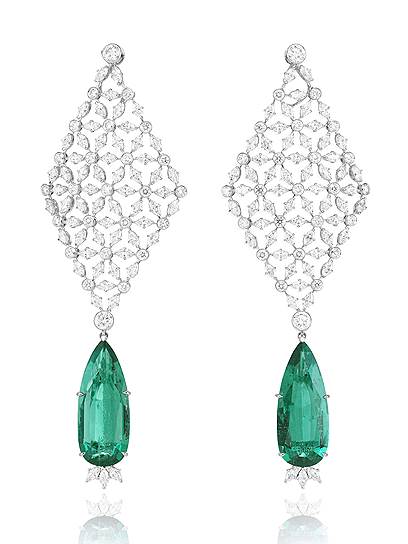
This year, we launched a major project with emeralds. Chopard partnered with Gemfields, a company involved in the mining, processing, and trading of emeralds, rubies, and amethysts. Gemfields’ CEO, Ian Harebottle, supports the idea of full transparency and traceability at every stage and is working with the RJC. The partnership produced the historic emeralds that Julianne Moore wore at Cannes—the first time in history that the provenance of an emerald could be traced all the way back to the mine.
Q: How do you track whether companies truly follow through on the commitments they make? Isn’t there a risk that these pledges remain mere rhetoric?
Livia Firth: Eco-Age acts as a completely independent evaluator, and we take on-site verification very seriously. When we assess a supplier, we actually visit the mines. Recently, our team travelled to Botswana and Zambia to monitor diamond production. Today, many argue that provenance for gemstones is as important as it is for fine art, but convincing brands to trace their stones is still a challenge. Chopard is currently the only brand willing to openly declare the exact mine its raw materials come from. At the same time, Carolina Scheufele understands that real change requires more than being an exception; the entire industry must be engaged.
Q: How is it working with Carolina?
Livia Firth: I love working with her. She has impeccable taste, drive, and business acumen. Looking ten years ahead, her concept of sustainable luxury is the right choice—not just ethically but commercially. Chopard has become a leader in the field. This year, the company posted record profits because everyone knows: if you want a piece of high jewellery made ethically, you go to Chopard.
We work with many brands and had repeatedly suggested they create collections for the Green Carpet. Most responded, “Yes, but then it implies the rest of our products aren’t ethical, right?” Carolina was the first person to say, “Rome wasn’t built in a day. We need to change, and if we need to change, we need time.” I literally jumped out of my chair with excitement: finally, someone bold enough to do it. I knew immediately this would be a brand led by a woman—because women are always bolder.
After launching the collection, journalists grilled us on the ethics of Chopard’s other products—but Carolina stood firm. The Green Carpet collection was truly revolutionary.

Q: Do you see overproduction as a problem in the jewellery industry?
Livia Firth: In the luxury segment, overproduction isn’t really an issue because jewellery is rarely discarded—it’s passed down through generations. But in the mid-market, absolutely. In fact, much of the provenance problem with diamonds originates there. When jewellery is sold at places like Walmart, tracing the stones is virtually impossible. As consumers, we have to ask ourselves: why are we trying to make jewellery more accessible when its historical role was quite the opposite?
Q: Understandable. And when it comes to super-profits, who cares about ethics and provenance? How do you respond to scepticism about your initiatives?
Livia Firth: I rarely encounter scepticism. Usually it’s a narrow-mindedness, a reluctance to look ahead. Any company that wants to remain profitable in 10–15 years must consider the sources of the materials used in its products today. Products rely on two things: people and materials. If you don’t figure out how to preserve both, there will be no business in ten years.
I wonder how long countries like Bangladesh, Cambodia, Myanmar, or Ethiopia will tolerate exploitative labour and cyclical poverty. In ten years, there may not even be water to irrigate the cotton fields that produce our fabrics. Failing to think seriously about this today is just foolish. It’s a complex challenge, and that’s why I admire Carolina so much—she’s taken on a very difficult task.
Q: How do you choose brands to work with?
Livia Firth: Sometimes they approach us; other times, we seek out key players to make an impact. For example, we work with Marks & Spencer, which in 2007 embarked on an ambitious sustainability programme. We monitored their progress and reached out because, like us, they oppose fast fashion—the cycle of buying weekly and discarding in months. Our collaboration provides alternatives for those who cannot afford Stella McCartney or Yves Saint Laurent. Last year, together with the UN, we launched the GCC Global Leaders of Change Award, recognising businesses that make the most significant contributions to embedding sustainable practices. Carolina received one of the awards, alongside Marie-Claire Davey from Kering, and two went to Unilever and Marks & Spencer. These four companies are doing extraordinary work.
Q: Your Green Carpet Capsule Collection for Net-a-Porter sold out immediately. How much advertising did you do?
Livia Firth: None, apart from the event featuring the designers: Christopher Bailey, Victoria Beckham, Christopher Kane, Erdem, Roland Mouret. I think women bought the pieces not just because they were ethically produced, but because the clothing itself was beautiful.
Q: Fur is making a comeback in fashion. Many brands claim their fur is sourced “humanely.” What’s your take?
Livia Firth: Fur is a minefield. We campaigned against fur for years, yet three years ago it resurfaced everywhere—keychains, pom-poms. Visit Portobello Market in London; nearly every stall has something made of fur. Where does it come from? Do designers not realise that what they showcase today will be copied by mass-market brands tomorrow, entering the fast-fashion cycle? High-end brands have responsibility: they shouldn’t create potentially dangerous, exploitative supply chains, as is happening with fur today.
I recently posted a vintage fur piece on Instagram, asking followers if they would wear it. Most said no, because even vintage fur carries the ideology of fur itself. In the past two years, the Kering Group has been studying the environmental impact of producing fur and exotic leathers, including python skin, through their Environmental Profit & Loss (EPNL) assessment system.
Q: Which industries are the most problematic?
Livia Firth: All of them. Cotton production is as dangerous as coloured gemstone mining—child labour, toxic chemicals, massive environmental strain. Every material today has problems. But as consumers, we have power: every purchase is a vote for—or against—certain practices.
Q: So you visited Bangladesh in 2009 and made a film about it. Why did you go in the first place?
Livia Firth: And I went again this year, and also to Brazil. I like to see our supply chains with my own eyes. Witnessing the people at the end of the chain is irreplaceable. However the first time I went to Bangladesh, I was a global ambassador for Oxfam, campaigning against domestic violence. In Dhaka, I was secretly taken onto a factory floor.
Q: How secretly?
Livia Firth: Almost like being carried in wrapped in the carpet. There I saw hundreds of women working 10–11 hours a day with a single break to use the toilet. The windows had bars. One entrance, one exit, guarded by armed personnel. A real prison. These women were sewing 150 pairs of jeans per hour. On top of that, they were abused daily. They couldn’t ask a manager for time off to care for a sick child—they’d lose their job. These were modern slaves, and it happens today, right before our eyes, driven by brands producing 40–50 collections a year. But who needs all this waste?
Q: But isn’t this called democracy—giving people the choice of what to buy? Or are we advocating for a USSR-consumerism model, where choices were minimal?
Livia Firth: Choice without responsibility is meaningless. True consumer power comes from asking where products come from, and who makes them.
Q: What’s your perspective on fast fashion today?
Livia Firth: You know, I’m 47. When I was growing up, nothing like this existed. I didn’t buy clothes every month—or even every year. I saved up for pieces, and they’re still in my wardrobe today. And everything looked great.
Now, most people shop at H&M, Zara, and other fast-fashion brands weekly. At Primark, people constantly buy items they don’t even wear. Understand this: Primark isn’t for poor families who can’t afford clothing. The owners of Zara and H&M are among the richest people in the world, according to Forbes, not because poor people can’t afford luxury—but because we buy garbage every day, produced by women working in inhumane conditions.
When I returned from Dhaka, I felt compelled to start a campaign exposing how clothes are made today. I want people to reflect: should these women be forced to work under such conditions? Why can’t they go to the bathroom or avoid abuse? They aren’t thinking, “I’ll be beaten, raped, enslaved in a cycle of poverty I’ll never escape.” They just want to earn enough to feed their children. And this system was created by fashion brands and mindless consumerism.
Q: After you released the documentary The True Cost, did you face threats or lawsuits from those implicated?
Livia Firth: None at all. You know why? Because the film shows the facts—there’s nothing to argue with.
Originally published at Kommersant (Kommersant is a leading Russian daily newspaper known for its in-depth coverage of politics, business, and culture, often regarded as one of the Russia’s most influential and authoritative publications): https://www.kommersant.ru/doc/3150108
 Articles on film, luxury lifestyle, culture and tech
Leave a comment