By Kristina Moskalenko
“I love projects like this: the more complex, the better,” admits the visionary behind some of New York’s most iconic landmarks.
When a metropolis like Manhattan has just a handful of parcels left for development, the pressure is on to make every inch count. And on Manhattan, ‘maximum’ means no less than 1,672,254 square metres of retail, residential, and office space, seamlessly woven into a singular skyscraper ecosystem — a vertical city where life, work, leisure, commerce, and art pulse through every tier.
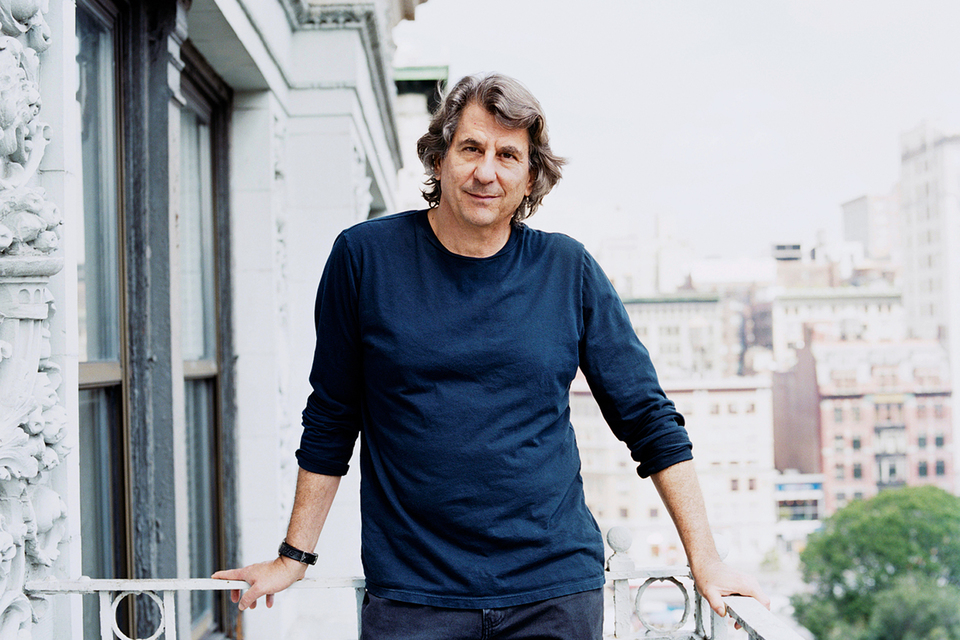
“It’s like Prada meeting James Bond,” says David Rockwell, architect of Hudson Yards — the largest private real estate development in the United States. We meet in a luminous showroom on the 29th floor, where a vast window frames the Statue of Liberty, the Hudson River glowing at sunset, and a dense lattice of city lights stretching into the distance. The atmosphere is that of a modern feudal lord surveying his glass-and-steel domain.
Hudson Yards, the last undeveloped site on Manhattan’s west side, is being imagined as a microcosm of the very best of contemporary urban life. By 2025, this stretch between 30th and 34th Streets will host a thriving hub of media firms, art galleries, and top-tier restaurants. Contracts have been signed with over a hundred retailers, including Neiman Marcus and Prada, while construction is well underway on a heated asphalt park designed for year-round use. Recently unveiled, Thomas Heatherwick’s striking sculpture — inspired by honeycombs and composed entirely of interconnected staircases — invites visitors to climb and capture the perfect selfie. In today’s architecture, photogenic appeal is a design imperative.
The district promises to become a new cultural nexus for the city, not least because it is home to The Shed: a six-storey, transformable theatre created in collaboration between Rockwell Group and Diller Scofidio + Renfro, a marvel of architectural ingenuity and artistic flexibility.
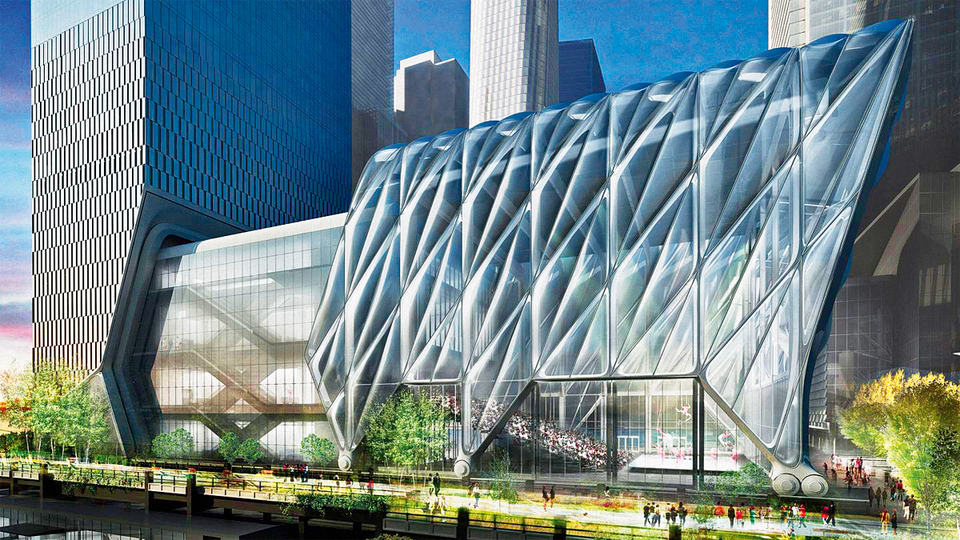
“This is the most complex project of my 30-year career,” says David Rockwell of The Shed, the pioneering cultural space that defies convention. “It’s a mobile building for performances and exhibitions, moving on eight wheels. Even the walls shift, reconfiguring this small space with big ambitions.”
Since the days of Lincoln Center, New York has not built a new cultural institution of this scale — a challenge Rockwell embraces with passion. “The demands on us are enormous. But I love projects like this: the more complex, the better.”
Once, 85% of Rockwell Group’s work was designing restaurants in New York. “But eventually, I got bored and started looking for different kinds of projects,” he admits. His pursuit of innovation led to the JetBlue terminal at JFK Airport, where he spent five years advocating to bring in a choreographer to design an intuitive flow for passenger movement. “Movement is a theme close to me,” he explains. “It inspired me to create the Valet furniture collection — 14 pieces crafted from leather, walnut, steel, and brass.”
“It’s clear the world doesn’t need another sofa,” Rockwell smiles. “But there isn’t much furniture designed for transitional moments — those corners where people don’t linger. I wanted to create a new typology. Valet reflects how I see the world: looking for gaps to fill. My furniture is flexible and practical for today’s life, when people are always on the move.”
Our conversation moves with us, taking place in the much-loved Union Square Cafe, whose interior Rockwell designed. Founded in 1985 with the simple goal of serving local food to the neighbourhood, the café was intentionally kept unpretentious, “homey” in spirit. Over its 31 years, it has become a New York institution — a place where, in pumpkin season, pumpkin dishes abound, and in apple season, apples take centre stage.
The café’s charm has endeared it to locals, each with a favourite table, a story, a family photo, a heartfelt attachment to the service. From 1992 onwards, it garnered countless accolades, including topping Zagat’s list of New York’s most beloved restaurants.
When it moved to a new location in October 2016, Rockwell faced a delicate balancing act: “How do you move, become more spacious, refresh the design, without losing the cosy, soulful atmosphere built over decades — a place where people come as if to their own home?”

In every project, we look for a narrative,” says David Rockwell, whose favourite table has always been number 36 at Union Square Cafe. “As a child wandering through New York, I was drawn to theatres and little restaurants — places that create memories. But what exactly do we remember? I believe it’s the moments of transition.”
Rockwell is adamant about his place at table 36. “If someone tried to move me to table 42, it would be madness.”
Over the years, both David and the café’s patrons have gathered countless cherished moments in the universe of Union Square Cafe. Determined to preserve this magic during its recent redesign, Rockwell set himself a daunting task: to identify the subtle details of the interior and spatial organisation that had won the hearts of visitors. Every inch was examined — the depth of the bar, the spacing between tables, the contrast of colours, the length of the lamps.
The result is what Italians call sprezzatura: complexity made to look effortless, something utterly new, yet imbued with a sense of the best, the beloved, and just for you.
Today, Rockwell Group undertakes up to 50 projects annually — from ambitious developments and Broadway sets to the mobile TED theatre. Yet it was between 1984 and 1994 that Rockwell first gained renown through his collaborations on restaurants and hotels, a specialty that remains at the heart of his work.

In 2015, Rockwell Group took on a distinctly different challenge: designing the first Virgin Hotel in Chicago. The brief was clear — translate Richard Branson’s spirited and playful airline ethos from sky to ground.
“Virgin has a recognizable standard of quality,” Rockwell explains, “but it’s not about traditional luxury. Virgin is always a surprise.” Case in point: the hotel’s bold red doors. “But that’s just the beginning.”
Aware that women now travel as much as men, Rockwell dedicated a disproportionately generous amount of space to mirrors and vanity tables. On the flip side, many guests conduct business meetings over breakfast — often right in their rooms. “So, we asked ourselves: why not make it comfortable to hold meetings sitting in bed?”
Branson’s guiding idea was that the hotel’s public spaces should evoke a private English club — exclusive yet welcoming.
Another unexpected project was the Edition Hotel on Madison Square, New York. The landmark clock tower, a proud and solitary somnambulist, had long stood aloof above the square, seemingly out of place. This classic New York building, with its stately oak paneling, was originally constructed in 1909 as the headquarters for the MetLife insurance company.
In the 1990s, the office relocated to a modern skyscraper, and plans emerged to convert the clock tower into apartments. But in 2012, the baton passed to Rockwell.
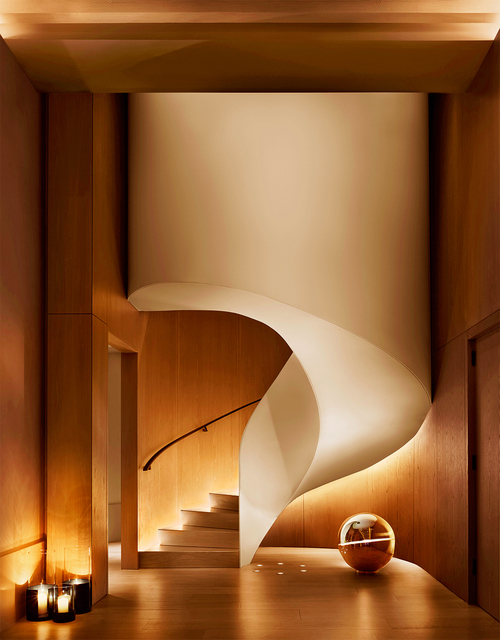
“It was a very dull building,” says project manager Jae Chan of the Edition Hotel’s clock tower, “and we faced every challenge that comes with adapting historic architecture for modern use. When you can’t touch the plasterwork, and the perfect spot for an entrance turns out to be a fire exit that can’t be moved…”
Inside, almost everything had to be reimagined, with spatial dimensions altered. “To replace all the windows, we crafted 31 different frame types.” Even the steel staircase connecting the lobby to the restaurant was engineered with near-Fibonacci precision, spiralling in harmony with nature’s mathematical patterns.
The result is Rockwell’s signature fusion of old and new. On one side, a sleek glass entrance, vast glass showers overlooking the park, a minimalist foyer staircase, and sliding walls in the rooms echoing the grand American-style headboards of oversized beds.
On the other, the dark carved oak of the restaurant, layers of jazz-era photographs, baroque mirrors, candles, and bold designer lighting create a warm, evocative atmosphere.
Since opening, Edition has maintained an occupancy rate of 92%, well above the industry average. The reason? The hotel possesses character and history, offering guests a refreshing sense of belonging to tradition. Its restaurant and bar have quickly become beloved by locals, cementing its status as a vibrant cultural hub.

A hallmark of Rockwell Group’s aesthetic is its fearless experimentation — not despite tradition, but because of it. Their latest New York project, the new Nobu in the former AT&T headquarters on Wall Street — a building locals affectionately call “the wedding cake” — is a case in point.
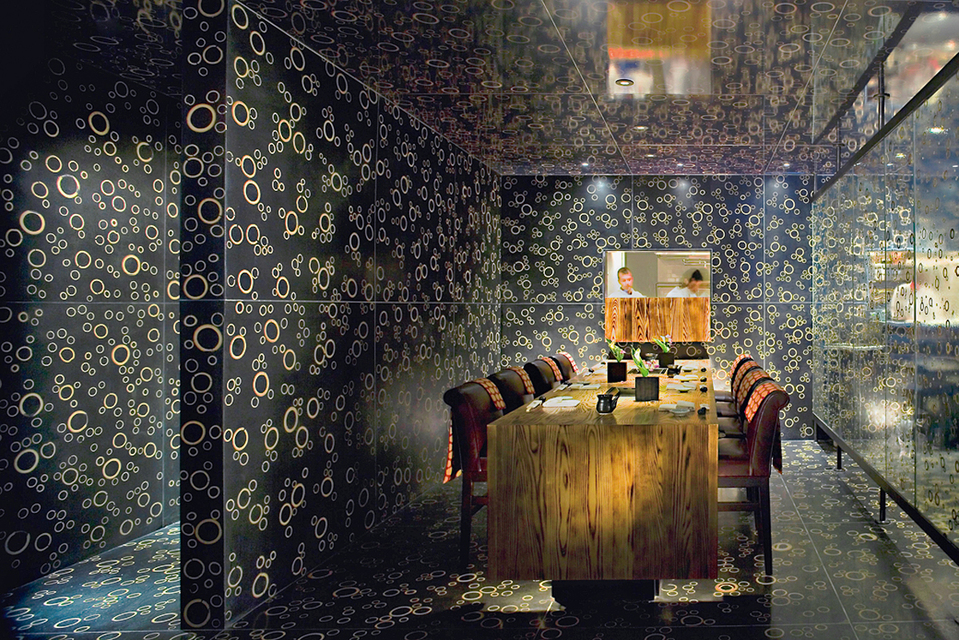
The restaurant is carved out, quite literally, from the building’s grand central volume, its presence delineated by sheets of glass. Within this corporate monument to another era now glows an onyx bar, soft-lit like a precious stone. Above, a vast calligraphic light fixture swoops through the space like an elegant ink stroke mid-air. Nearby, whimsical childlike sculptures inspired by Asian folklore add an element of quiet play.
Despite the layered luxury, the new Nobu has the spirit of a pop-up — impermanent, improvisational — embedded within the bones of a serious corporate edifice. The building still boasts pneumatic mail tubes and hulking elevator shafts, ghosts of another century’s idea of communication and flow.
What Rockwell achieves here is more than aesthetic: it’s a repurposing of history. Classicism doesn’t collapse under the weight of modernity — instead, it yields to it, reconfiguring its purpose under the persistent pressure of Rockwell’s creative energy.
“What doesn’t change,” Rockwell reflects, “is that people still want to spend time with other people.” It’s this enduring truth, he believes, that will keep reshaping the architecture of experience. “That’s why I think the pop-up format will evolve — not for a week or a year, but perhaps for five.”
After all, in a world that’s increasingly transient, Rockwell’s designs remind us that impermanence can still feel like home — if only for a little while.
Photography: Nikolas Koenig, Emily Andrews, Christopher Sturman. Courtesy of Rockwell Group in collaboration with Diller Scofidio + Renfro.
Originally published at: https://www.vedomosti.ru/kp/humans/article/2017/04/05/684278-smeshat-i-vzboltat#/galleries/140737493212711/normal/1
 Articles on film, luxury lifestyle, culture and tech
Leave a comment