
By Kristina Moskalenko
This week, Spectre—the 24th action-packed James Bond film—premieres in cinemas. The franchise took a bold new turn in 2006 with Daniel Craig, who redefined 007 as a more complex, emotional, and human character. Since then, each film has pushed deeper into darker, more realistic territory, resonating with modern audiences.
Women in the Bond universe have evolved too. In Casino Royale, Bond experienced real love and heartbreak. Skyfall focused heavily on his female boss, M. And now in Spectre, we witness a milestone: for the first time, James Bond falls for an older woman—the mysterious and elegant Lucia Sciarra, portrayed by 50-year-old Monica Bellucci.
In our exclusive interview, Monica Bellucci shares her thoughts on how the role of women in cinema has changed by 2015, the ongoing challenges faced by actresses over 40, and how to embrace life and confidence at any age.
Kristina Moskalenko: Do you remember the moment you were offered the role of a Bond girl in Spectre?
Monica Bellucci: I do. I was in Paris when Sam Mendes called. Honestly, I was stunned. I thought, “Me? In a James Bond film?” It was so unexpected. But then Sam told me about the role, and I saw it wasn’t just about being another Bond girl—it was something deeper. Something that could challenge the idea of what a Bond woman is supposed to be.
Kristina Moskalenko: What made say yes?
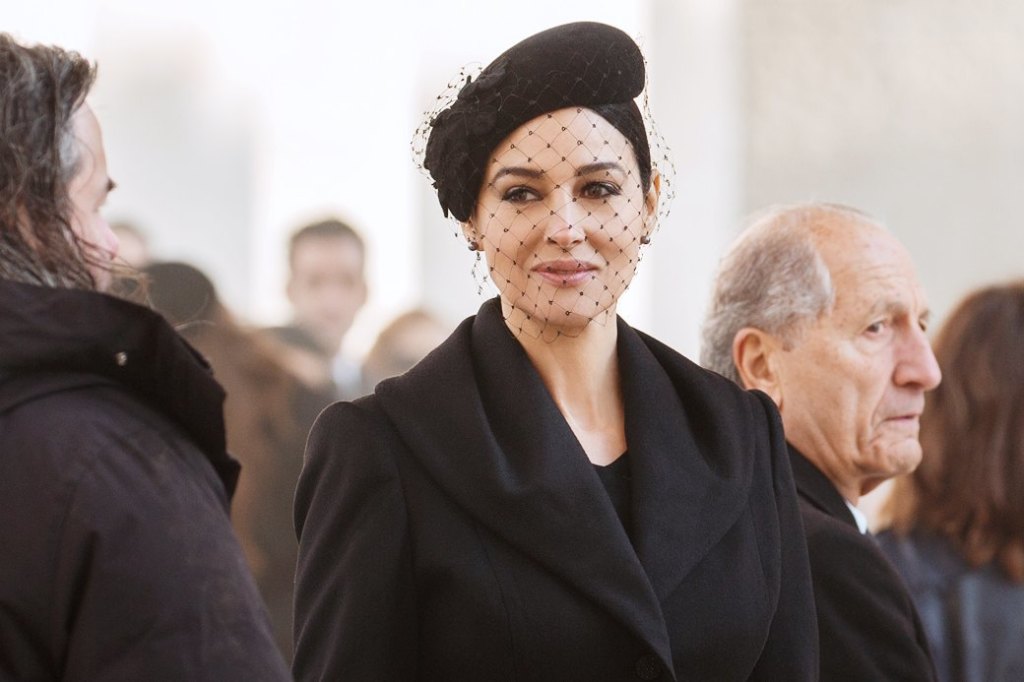
Monica Bellucci: For the first time, Bond shares the screen—and a bed—with a woman older than him. That alone makes it powerful. The scene may be short, but emotionally, it’s like a crescendo. It starts with silence, with shadows. We meet Lucia in a cemetery—her husband has been murdered, and she knows she could be next. She’s cornered and alone.
And then Bond arrives. He isn’t just a spy in that moment—he’s her last hope, her lifeline. Sam was very deliberate—he wanted a real woman, someone who is fifty and unapologetically looks it. The vulnerability, the solitude, the weight of years—all of that needed to be visible. The scene is dark, moody, intimate. And within that darkness, something symbolic happens. We see that sensuality doesn’t belong only to the young. It comes from presence, from experience. From within.
Kristina Moskalenko: And yet your final moment on screen is quite striking—sitting on a bed in a corset. Was showing the physical beauty of a 50-year-old woman part of the message?
Monica Bellucci: I watched the film again just recently and thought—yes, we created a quiet revolution. A provocation, wrapped in silk and shadows. It’s still Bond, but something has shifted.
What I hope people see is this: women on screen can have lines, flaws, the texture of life—and still be completely magnetic. That is real femininity. That’s a modern concept. My character, Lucia, wears the corset not to hide anything—but to show that even at fifty, a woman has the right to be a woman.
Kristina Moskalenko: Very true! But how about the second Bond Girl in Spectre—Dr. Madeleine Swann (Léa Seydoux). She isn’t exactly typical for the Bond universe too. She has a doctorate, a career…
Monica Bellucci: I wouldn’t be so harsh on Bond girls. Playing Bond’s companion is like doing something historic—becoming an icon, part of a tradition. All Bond girls have to show feminine strength as it’s understood in their time. The role requires a clearly expressed femininity. It’s very cinematic. I think Famke Janssen did a great job. Eva Green, Rosamund Pike, Sophie Marceau—they’re all excellent Bond girls! But you’re right, the story of Spectre is much closer to reality than usual. Madeleine Swann is smart, she works, makes decisions, takes action—and Bond needs her. She represents the present and the future. Lucia, whom I play, symbolises the past—a woman who wants to break free but can’t because she lacks the means and strength. She has no freedom, follows the rules even if she dislikes them, and she’s afraid. It’s interesting how Madeleine and Lucia, metaphorically white and black, represent two different types of women. But I like being James Bond’s lady.
Kristina Moskalenko: You wanted to play a Bond girl when you were 24. How do you think your career would have turned out if that had happened?
Monica Bellucci: Yes, then Bond was Pierce Brosnan. Maybe I was too young to play a Bond girl? (Laughs.) I read an interview with Carole Bouquet, who said she didn’t work for five years after Bond. There’s a chance that if it had happened back then, I wouldn’t have a job today. I think everything has its time. In my opinion, it’s much more interesting to act in a modern James Bond film. Ten years ago, I never imagined I’d play a Bond lady at fifty. Besides, things are changing. I don’t think Léa will be out of work for five years—her big international career is just beginning.
Kristina Moskalenko: In recent years, Hollywood has been speaking more and more openly about how few roles there are for actresses over forty. Is this a real issue for you personally?
Monica Bellucci: I think about it often. In the 1940s and ’50s, many talented and beautiful actresses simply stopped working in Hollywood after a certain age—and it was the same in Italy. It’s hard for me to say if things are changing in Hollywood because I’ve never lived there or gone to meetings with agents or directors—I’ve always worked through Europe. But here in Paris, where I live, I regularly see Catherine Deneuve, Isabelle Huppert, Nathalie Baye, Helen Mirren, Judi Dench in films. It seems European cinema is learning to recognise beauty beyond youth. Overall, the situation is slowly improving. Only look at Julianne Moore in David Cronenberg’s Maps to the Stars—she fully embraces her body, turning it into art.
I love seeing actresses enjoy that freedom. I also really admire Charlize Theron—a brave and wonderful actress.
Kristina Moskalenko: Returning to Spectre, what quality do you admire most in Bond?
Monica Bellucci: That there is no one like him! I’ve never met anyone even remotely like him. He is both rational and sentimental at once. I like that balance, but in real life, it’s very rare to find someone who can maintain it. Bond is created as an ideal, the ultimate dream: a protector, brave, a gentleman, mysterious, unpredictable.
In my view, Sam Mendes and Daniel Craig created a new, very modern Bond—one who is human, accessible, and relatable. Craig, as an actor, radiates both danger and emotional depth, and he is very elegant. Have you seen him in Infamous by Douglas McGrath? It’s a perfect mix for today.
Sean Connery’s Bond is wonderful too, but that’s a very different, traditional Bond. It’s incredible that this franchise not only survives but grows stronger. Today, James Bond is an institution—how has it lasted so long?
Kristina Moskalenko: How did you prepare for the role of Lucia? Dieting, beauty salons? Or did you just play “the Italian woman”?
Monica Bellucci: I didn’t prepare. But Sam Mendes knows how to conduct actors like an orchestra. He’s a fantastic conductor. Acting is about expressing feelings. For an actor, the body is just an instrument—like a piano for a pianist or a manuscript for a writer. But it’s a direct instrument, like dancers use—no filter at all. If an actress expresses something through her appearance, that’s great. Either way, Sam Mendes always manages to get the perfect note out of everyone.
Kristina Moskalenko: While filming Bond, you were also working with Kusturica. Does he have his own method?
Monica Bellucci: I’ve been filming On Love and War with Kusturica for three years now; we finish in November. His working method is very different from Sam Mendes’s. Directors from different countries are different, and I learn from all of them, gaining new experience with people and understanding different approaches to cinema around the world. That’s just who I am: I love to travel, learn new things, I’ve never stayed at home. My mom always said, “Be sweet like Madonna, and strong like an angel sent to fight a demon.” Over time, I’ve learned to stay open, not to be afraid, not to block myself from life. Yes, some doors close right in front of you, but that’s an opportunity to learn something. Age brings its benefits: my first daughter was born when I was forty, the second at forty-five. When I was twenty, I never thought the best moments in life would come after thirty! Yes, youthful beauty fades, but another kind comes, and we learn so much. Life is very interesting.
Kristina Moskalenko: Your daughters are 11 and 5—at what age would you show them 007: Spectre?
Monica Bellucci: I hope they’ll have other things to do besides watching my films! And they should see me as their mom, not as an actress. An actress for everyone else, but for them, just mom—not a picture, but a woman.
Kristina Moskalenko: You once said good food, good drinks, and good sex are important in life. Do you still stick to that?
Monica Bellucci: Absolutely, yes. Living well is what we all need. But living well isn’t easy. It’s often easier to see the bad than to enjoy life. But you have to find the courage to enjoy life.
Photos: WDSSPR
Originally published at Wonderzine: https://www.wonderzine.com/wonderzine/entertainment/interview/215695-monica-bellucci

 Articles on film, luxury lifestyle, culture and tech
Leave a comment