
By Kristina Moskalenko
David Downton exudes an unexpected modesty. His voice is soft, his British accent impeccable, and his vocabulary so rich that I found myself reaching for Oxford English Dictionary. We meet at Claridge’s, where he holds the enviable title of “artist-in-residence.”
“It simply means I paint the guests that the hotel selects,” he explains, a hint of amusement in his voice. “Usually, they are figures of note, people who have shaped the story of this legendary institution.”
Downton himself resides outside London, having grown up in the quaint city of Canterbury, Kent. “I never set out to be an artist for art’s sake,” he admits. “For me, drawing was always a craft to master, a skill to earn a living from. I would take on anything, no matter how big or small, if it allowed me to perfect my hand. In the 1970s, the world of fine art and commercial art barely intersected. Today, someone like Damien Hirst has made that fusion seem effortless. Back then I didn’t look at myself as a pure artist, I was always into commercial illustration.”
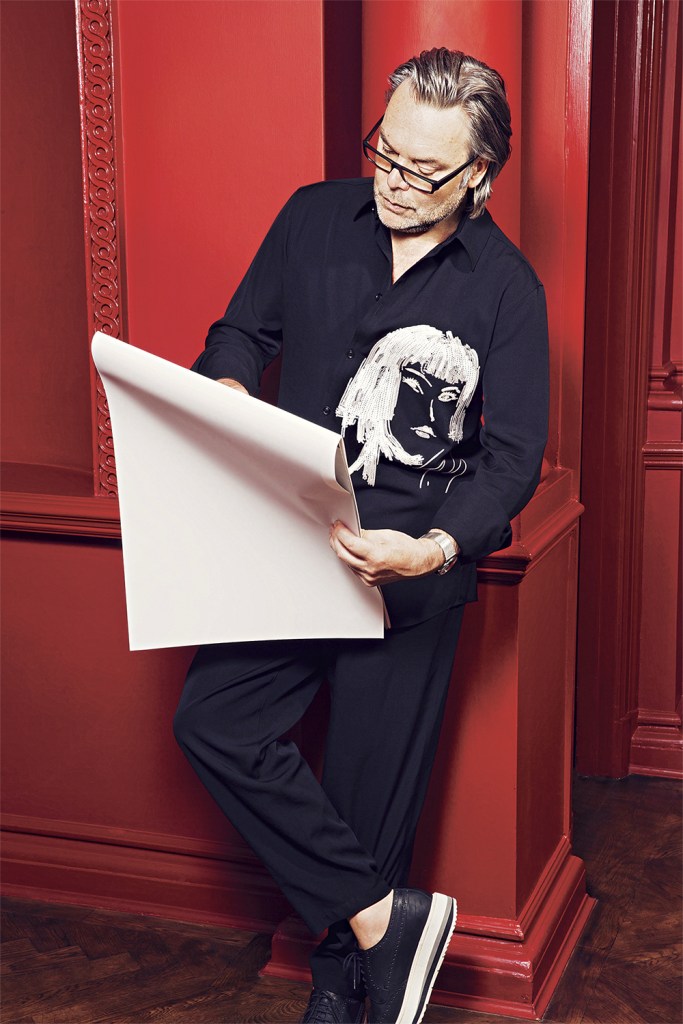
According to Downton, career plans were never part of the equation. “I just kept working constantly,” he admits. “I drew countless illustrations for women’s novels that appeared in magazines at the time. I never said no—every commission was a problem to solve for me, and I enjoyed that. I did it all until I was thirty-seven.”
Eventually, the creative omnivorousness began to pall, but fortune smiled on the artist. Soon, he received a career-defining commission from the Financial Times.
“They sent me to sketch couture shows in Paris. Up until then, I often worked for fashion magazines, but usually I was sent photographs of garments, or clothes to dress the model I was drawing. I had never experienced a live fashion show! My first was Versace at the Ritz—Naomi, Linda, Christy Turlington. It felt like landing at the Super Bowl of fashion and being handed the keys to a magical kingdom. At the same time, I knew I had arrived exactly where I belonged.”
Since that first show, David has never missed a couture presentation from his favourite houses. And he kept sketching, tirelessly.
“I have always adored Christian Lacroix’s shows, though they were a challenge to capture: theatrical silhouettes, countless details, patterns, lace, fabrics, embroidery, references to literature and culture—and the colour! Lacroix is a magician with colour. Once, I was backstage as he selected coloured ribbons from a catalogue. Like a bird, he plucked ribbon after ribbon—tick, tick, tick. At first, I thought he was choosing odd, mismatched colours, and I eventually blurted out, ‘Why pick colours that don’t match?’ He held the ribbons together—and I gasped. It was a symphony!”
By contrast, Yves Saint Laurent’s shows, he says, were a dream to sketch: “Simple silhouettes, either delicate or sharply defined lines, magical colours and combinations—like chocolate and deep navy. Who could have conceived pairing them?”

David’s favourite show? John Galliano for Dior in January 1998 at the Palais Garnier. “There was tango, maharajahs, pure extravagance. The budget was around €4 million for ten minutes. Shows at the time were extraordinary—astronomical budgets. Versace, Saint Laurent, Ungaro, Lacroix were all alive then. It was breathtaking!”
That same year, Downton held his first exhibition of fashion illustrations. The works sold instantly. Among the visitors was the model of the moment, Marie Helvin. “And suddenly I heard myself ask her, ‘Would you like to sit for a portrait?’” David’s eyes widen. “She said, ‘Of course!’ She even requested postcards of her portrait, sending them to Joan Collins, Catherine Deneuve, Paloma Picasso, Jerry Hall. After that, many celebrities wanted a Downton portrait: Iman, Naomi, Linda, Cate Blanchett were among the first.”

David immediately noticed an intriguing detail: none of his subjects ever behaved like divas. On the contrary, they revealed a surprisingly human, everyday side. Why? “These women have been photographed so many times that, by now, they could have holes in them,” David laughs. “When it comes to photography, they often know more than the photographer. But with drawing, they know far less. So, when they agree to a portrait, in a way, they’re placing themselves in my hands. I’ve never had any difficulties with any of them.”
He recalls Sarah Jessica Parker arriving for a portrait session at Claridge’s after a long shoot, sitting on the sofa, and asking, “Can I just take off my shoes and watch TV?” Catherine Deneuve, meanwhile, battled protesters and torrential rain to reach his studio. “I was about to call and cancel everything, but then Deneuve arrived—soaked to the skin—went into the bathroom, and emerged—pure Deneuve!” he smiles.
Today, Downton works exclusively on paper and from life (apart from portraits of 1960s cinema icons). Computers, he says, offer too little freedom. To achieve the signature single-stroke fluidity in his work, he makes 20–30 preliminary sketches with the model, followed by 15–20 iterations in the studio. “I never show the model the work until I am entirely satisfied with it myself.”

David is also the author of two acclaimed books. Portraits of the World’s Most Stylish Women (2015) showcases portraits and captivating stories of the planet’s most elegant ladies, while Masters of Fashion Illustration (2010) delves into archival material and the works of legendary fashion illustrators.
“When I started, Mats Gustafson, the Swedish fashion illustrator of the 1970s, was already drawing for Vogue Italia,” David recalls. “But beyond that, fashion illustration was largely unknown to me. I immersed myself in the biographies of past illustrators, studying how they lived and worked, not just their use of color and form. I admire many, but if I had to pick one favourite, it’s René Gruau. Once Valentino even told me I am today’s Gruau—I was ecstatic! Gruau reached near-genius in his craft: his sense of graphic design and drawing, from 1945 to 1980, is flawless. I also love Antonio Lopez, Marcel Vertes, and René Bouché, who captured all the celebrities of his era.”
David smiles at the memory of meeting Bouché’s widow. “She told me how Sophia Loren once arrived at their room in the Hôtel de Crillon, Bouché drew her, and then they went to lunch alltogether. The star not only devoured her own spaghetti but also a portion belonging to Vogue editor Denis Lawson-Johnston! Imagine that! I’ve also accessed the Vogue archive and found telegrams where Bouché says he’s tired and will stay a few more days at the Ritz—the bill to Vogue. Another telegram shows him ordering shirts on Savile Row—the bill again to Vogue! Whether they actually paid or not, illustrators were absolute superstars back then.”

In 2009, David also collaborated with Vogue, illustrating the cover featuring actress Cate Blanchett for the 50th anniversary of Vogue Australia. “I wasn’t entirely sure the illustration would even make it to the cover,” he admits, “because I was always told that drawings don’t sell magazines.”
But the cover was released in four variants and became the fastest-selling issue in the magazine’s history. It was even crowned Cover of the Year.
“Today, magazines tend to use illustration when a high-quality photo isn’t available or when they want to do something ‘new.’ I remember once at a Galliano show for Dior in Paris, one model saw me drawing her and said, ‘Oh, that’s something new!’ It’s moments like that that remind me why I love working this way.”
Originally Published:
 Articles on film, luxury lifestyle, culture and tech
Leave a comment