Interview by Kristina Moskalenko
With the release of The Grand Budapest Hotel, we sat down with Wes Anderson to talk Eastern Europe, fake paintings, and men’s fashion.
I had the privilege of being the very first journalist to interview Wes for this film on that day. When I entered the room—located not in a hotel, but a classic gentleman’s club—Wes and his assistant initially tried to seat me on a chair. But then, in a moment that felt straight out of Titanic, Wes started moving a sofa just for me, like Leonardo DiCaprio did for Kate Winslet in that iconic drawing scene. Throughout our conversation, Wes didn’t sit upright; he half-lounged, exuding the cool, laid-back vibe of the auteur himself.
Kristina Moskalenko: They say you dress like the characters in your films. What are you wearing today?
Wes Anderson: Oh, nothing out of the ordinary. No cologne even. I tend to wear the same things — usually some tweed I like. People like to make a big deal out of it, though.
KM: The Wes Anderson Collection book came out this fall. It’s structured like a journey through rooms, each one representing a phase of your creative life. If we imagined ourselves in your “creative” room right now, what would it look like? The walls? The furniture?
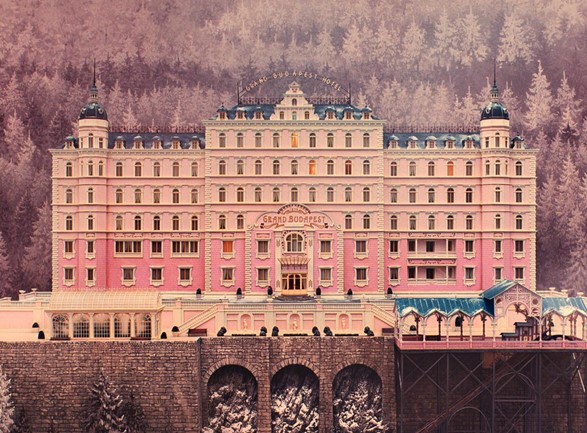
WA: Probably white and empty. Every time I start on a new movie, it’s like stepping into a new room — I try to create a new mood. But I always begin with something very plain, very bare. When I’m writing, I like to work in different rooms, in different countries. It keeps things interesting. As for The Grand Budapest Hotel, if I use your metaphor, it’s got several rooms — because it covers different time periods. The idea was to make the movie as if it were made in old Hollywood. Except instead of building all the sets on a backlot in California, we went to the actual place where the story unfolds — right on the border between Poland, Germany, and the Czech Republic — and tried to recreate its past.
KM: Zubrowka, where it all happens? That’s not a real country. It’s a vodka brand.
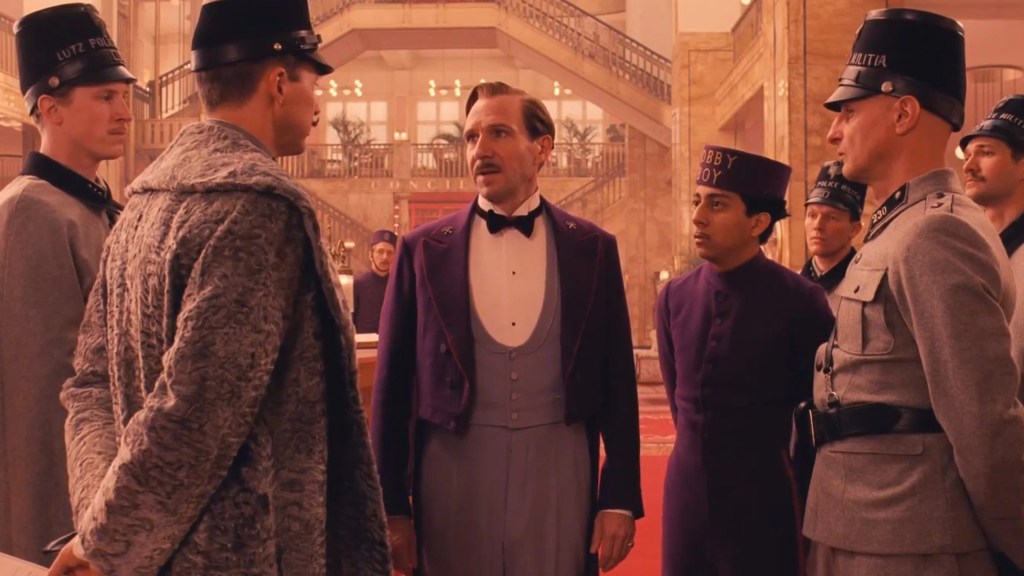
WA: Yeah, we invented Zubrowka. It’s a fictional country based on some research about Eastern Europe from 1913 to 1931. We were inspired by old photographs and my travels.
KM: You really captured the spirit of Eastern Europe in this film. I’m from there, and watching it made me miss home.
WA: At first, we planned to shoot in Hungary, then switched to the Czech Republic. But in the end, Germany offered the best tax breaks for filmmaking, so that’s where we went. We scouted old hotels in tiny towns all over the region. Some of those hotels from photos taken in 1905 still stand. What was striking was seeing the impact of fascism and communism on these buildings. Some parts were untouched — beautiful murals, architecture, details preserved. Other parts had lowered ceilings, and large rooms split up with partitions. Fascism and communism aren’t themes in the script. We just wanted to show a grand hotel that had fallen into decline. But seeing all this, we realised we were really telling a story about changing ideologies. It made the movie richer, I think.
KM: I guess when you’re in Germany, it’s hard not to notice how all the political changes of the 20th century have left their mark?
WA: We were in West Germany, and there’s almost nothing left from the past. People had money, so they tore down the old and built new. But in East Germany, we found lots of abandoned buildings that tell the story of the communist era: small rooms, typical wallpaper, but also these magnificent old stoves in every room — so heavy and massive that no one even tries to steal them. I wanted to take those stoves for the movie, but they were immovable, so we had to build our own.
KM: I noticed all the men in The Grand Budapest Hotel have mustaches. In Eastern Europe, many men really do wear mustaches, unlike Hollywood.
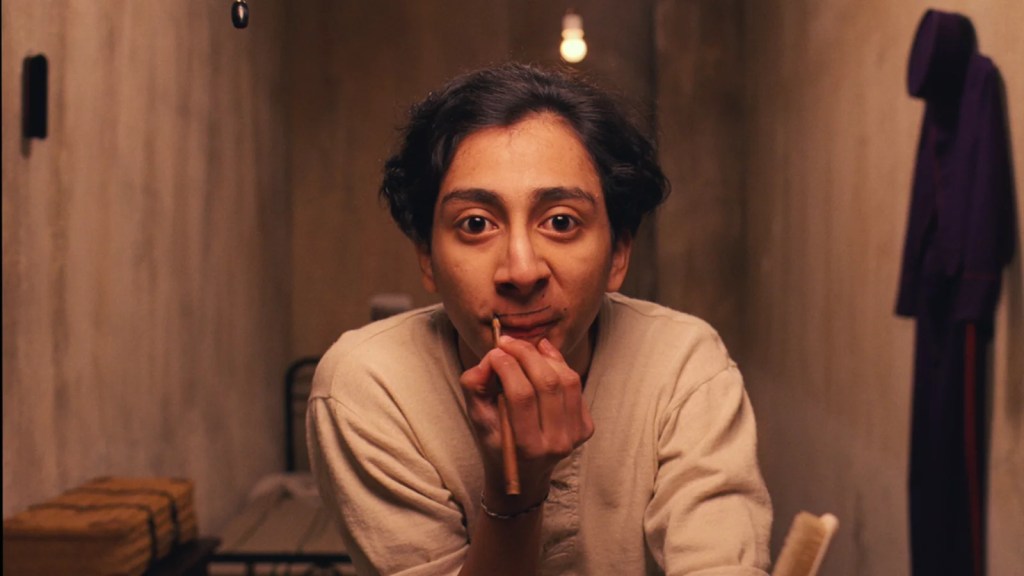
WA: Yes, every male character has a mustache because I wanted to capture the style of the Austro-Hungarian Empire between 1913 and 1932. In all the photographs taken before World War I, men always have mustaches. I even asked the whole crew to grow theirs out because if I suddenly needed someone to play a driver — I’d need a guy with a mustache! Almost all the mustaches on screen are real, not fake.
KM: Indeed, everyone’s sporting a mustache — except the boy with the apple in the painting that the story revolves around. It’s a Renaissance-style portrait, and I’m sure it’s full of hidden symbols.
WA: The painting is a key part of our story. Making a painting for a movie is a long process — it’s a work of art in itself. Usually, paintings for films start being made about three weeks before shooting, but we took a different approach. We began a year ahead. First, we found the website of the British Royal Society of Portrait Painters, which showcases many artists. You can commission a portrait for three thousand pounds, or find someone who charges ninety thousand. I liked the work of an artist named Michael Taylor, whose pieces I’d seen at the National Portrait Gallery in London. He decided the painting needed a real boy to pose for it. So, we held a casting — just like for an actor — and found the boy who is now immortalized in the portrait.
Costume designers Robert Worley and Milena created a period outfit for him. Michael chose an old church in the part of England where he lives and set up a studio there. We wanted the portrait to evoke the style of Bronzino and Hans Holbein. Were they pre- or post-Renaissance? Either way, they were our guides. And naturally, Michael hid many little symbols in the painting — just like painters did back then.
KM: But that’s not the only painting in the film. You also have Schiele, Klimt, and a Van Gogh–style sky. Who’s your favorite artist?
WA: I like Schiele and Klimt. The Schiele in the film is fictional — we simply asked an artist named Rich Pellegrino from San Francisco to paint something in Schiele’s style. I saw his work a couple of years ago and couldn’t forget it. And remember at the beginning of the film, when the girl walks through the cemetery and there are three bearded men in black sitting there? They’re three brothers from Russia who paint copies — forgeries, really. They painted all those beautiful Klimts that appear in the movie. Now they’re all with me. But the biggest inspiration for us was Caspar David Friedrich’s landscapes. You can see our interpretation of his work on one of the walls in the hotel’s restaurant, based on real locations. As for Van Gogh, I don’t actually recall him being there.
KM: There’s a shot over the castle where the dark sky swirls like in Van Gogh’s Starry Night. Maybe that was just the real sky?
WA: Could be!
KM: You travel around Eastern Europe with your favorite troupe — Tilda Swinton, Edward Norton, Owen Wilson. What is it about these actors that keeps bringing them back to your films?
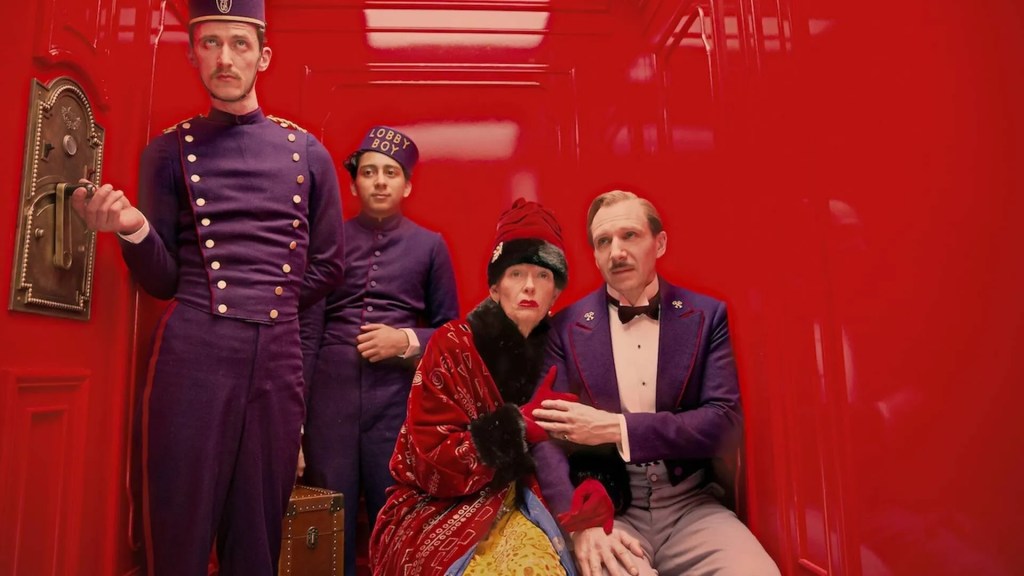
WA: Most actors I work with are people I admired from films I’d seen before meeting them. With Tilda, everything aligned: she’s a wonderful actress, has a striking presence, and is incredibly daring. She’s willing to go anywhere creatively. Beyond that, Tilda is a conceptual artist — she’s open to the world a bit more than most. She’s fascinating to work with. She doesn’t just focus on the role; she’s open to all possibilities. On set, she’s lively and ready to move in any direction you suggest.
KM: Is Edward Norton also a conceptual artist?
WA: I first saw Edward in The People vs. Larry Flynt and later in the theater production of Lanford Wilson’s Burn This. I was struck by how powerful an actor he is. Owen and I went to college together. We’ve known each other since we were 18. He’s my closest old friend. We started out together, so we’re more than just colleagues — we’re kind of family.
KM: Do you compete with each other?
WA: No.
KM: What makes you happy?
WA: I’m happy when I’m shooting a film. Then I’m happy when the shooting ends and there’s nothing to do. I like to go out for lunch, read a newspaper. But not long after, for my own happiness, I have to start something new and work at a crazy pace again. It’s different every time. The one constant is that when all the scenes are shot, the only thing I want is to finish quickly. I really love when we begin editing and working on the music. In other words, I guess I’m happiest when there’s always something changing around me.
Originally published at Interview Magazine Russia

 Articles on film, luxury lifestyle, culture and tech
Leave a comment