
By Kristina Moskalenko
Photography: Kurt Iswarienko
Styling: Erin Walsh
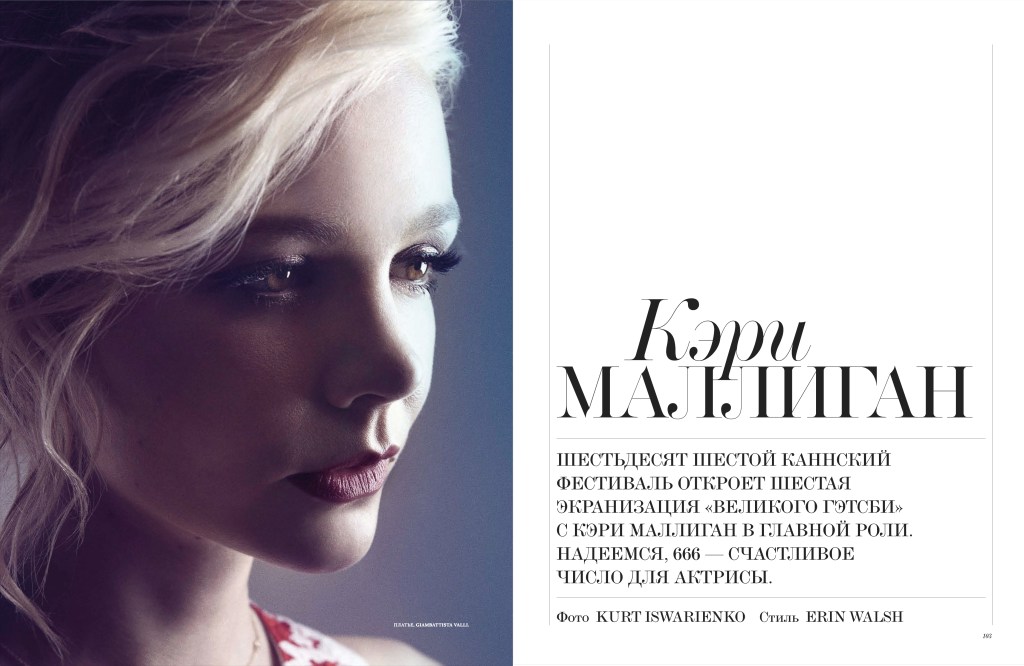
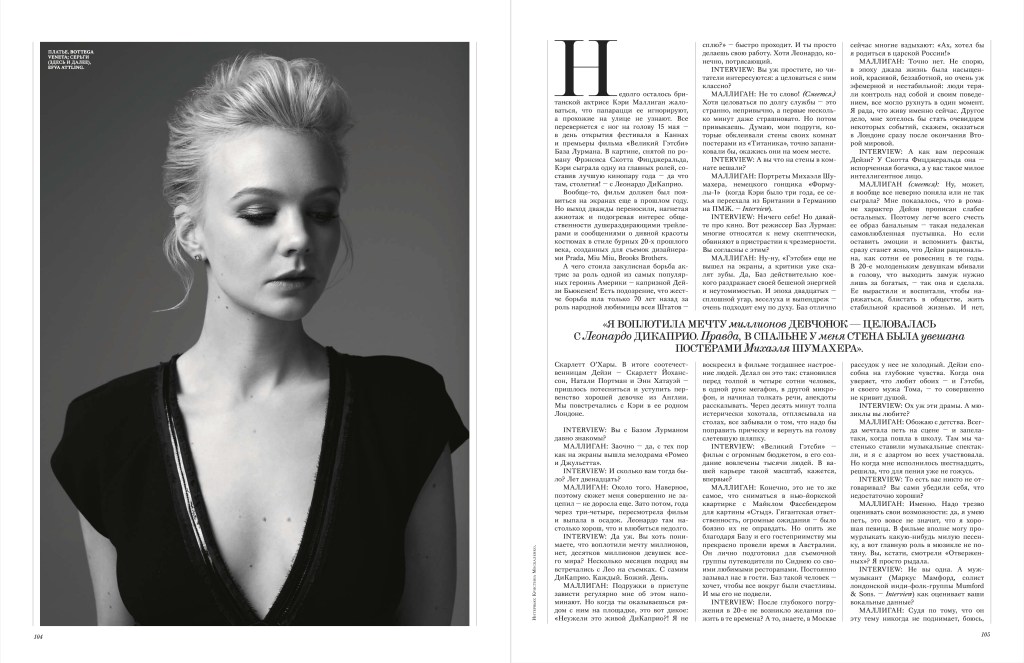
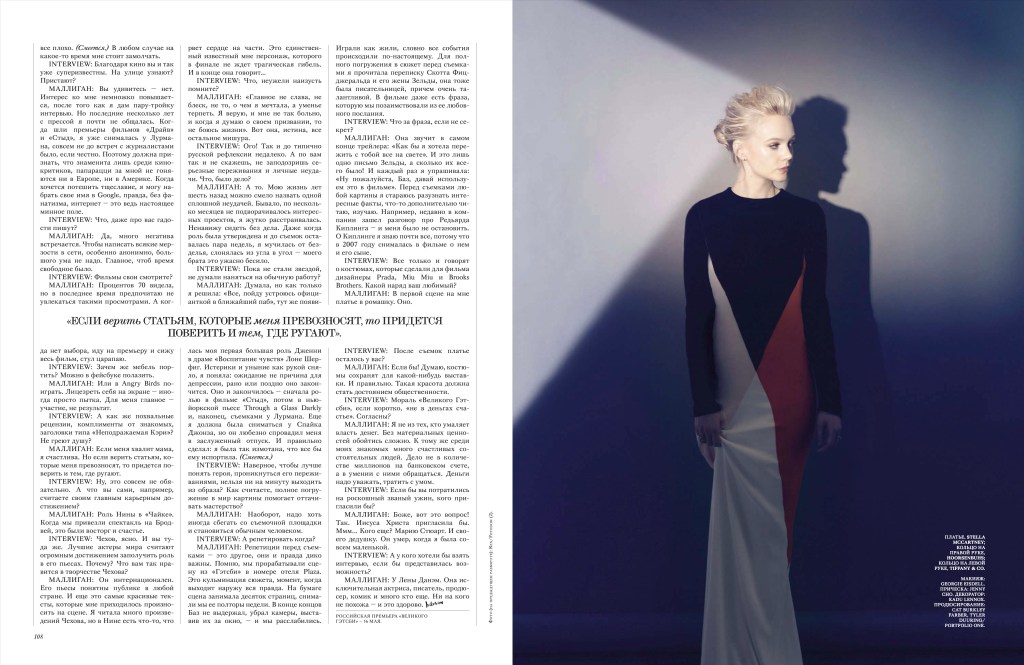
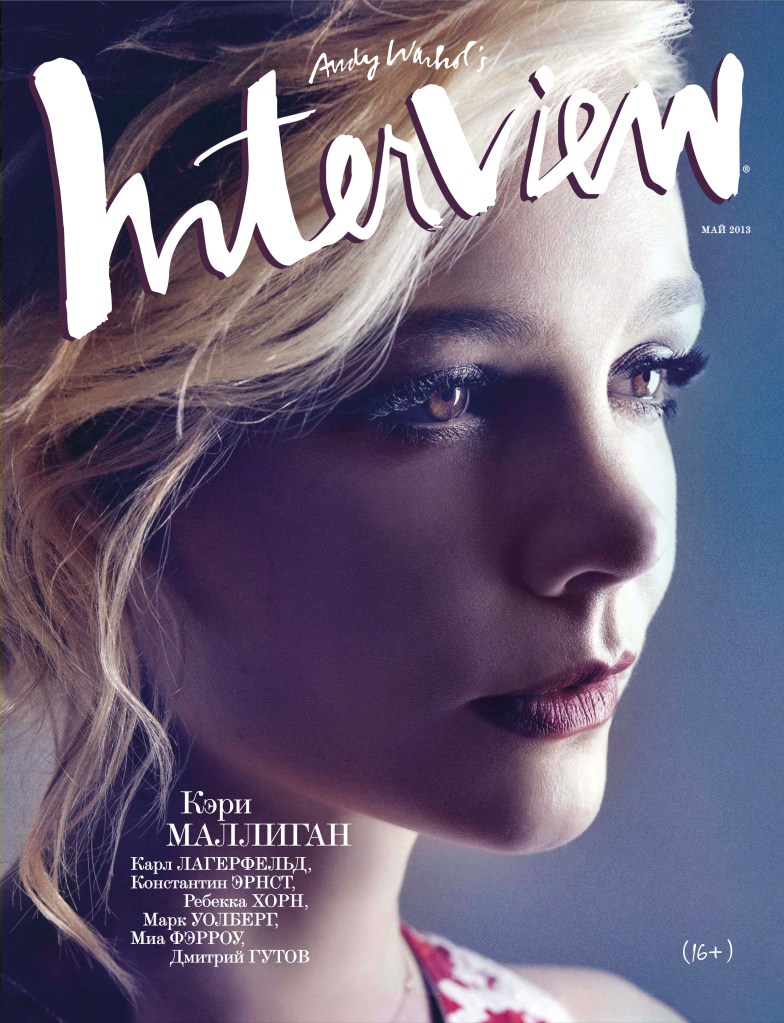
On May 15, Carey Mulligan goes from indie darling to full-blown movie goddess. That’s the day Baz Luhrmann’s The Great Gatsby opens the 66th Cannes Film Festival—and the day Mulligan steps into the most coveted pastel heels in American literature: Daisy Buchanan’s.
You know Daisy. Champagne voice, devastating smile, casually ruins lives. She’s the glittering girl who’s launched a thousand screen tests.
Insiders say it was Hollywood’s fiercest casting war since Vivien Leigh snagged Scarlett O’Hara. Names floated: Scarlett Johansson, Natalie Portman, Anne Hathaway. But in the end, the crown went across the pond. Mulligan, the London-born actress known for breaking hearts in An Education and Shame, beat them all with a mix of vintage poise and modern melancholy.
We met up with her in London a few weeks before the premiere. She was sipping tea, dressed like the kind of girl who might read Virginia Woolf on the tube—but definitely knows her Prada from her Miu Miu.
“It’s surreal,” she said. “I mean, it’s Gatsby. And Leo.”
Yes—Leonardo DiCaprio. If there’s a hotter on-screen pairing this century, we haven’t seen it.
Luhrmann’s vision? Maximalist, operatic, soaked in jazz-age decadence. Think roaring ’20s, on steroids. The costumes—yes, those Gatsby costumes everyone’s already losing their minds over—come courtesy of Prada, Miu Miu, and Brooks Brothers, shimmering with Gatsby’s signature excess.
The film’s original release was delayed twice, which only hyped the hysteria. Now it’s finally landing at Cannes 2023, ready to blow up timelines, trend hashtags, and maybe win a Palme d’Or while it’s at it.
Carey? She’s ready. Paparazzi-proof shades on. Lips painted Gatsby red. About to go from BAFTA girl to global icon.

INTERVIEW: You’ve known Baz Luhrmann for a while?
MULLIGAN: Only from afar, really—since Romeo + Juliet came out.
INTERVIEW: How old were you then? Twelve?
MULLIGAN: About that. I don’t think I fully understood it at the time—I was a bit young. But a few years later, I watched it again and was completely blown away. And Leo… I mean, it’s impossible not to fall for him in that film.
INTERVIEW: Exactly. Do you realize you’ve lived the dream of millions—no, tens of millions—of girls around the world? Months on set with Leo. Leonardo DiCaprio. Every. Single. Day.
MULLIGAN: Yes, my friends like to point that out rather a lot. But when you’re working with him, that whole surreal “Is this really happening?” thing disappears quite quickly. He’s just incredibly professional and generous. You focus on the work.
INTERVIEW: Be honest—what’s it like kissing him?
MULLIGAN: (Laughs.) Oh, well—it’s certainly not a hardship! But it’s also part of the job, and honestly, quite technical. The first time is always a bit nerve-wracking, but then it becomes… choreography, really. Still, I think my friends—especially the ones who had Titanic posters on every wall—would have completely lost it.
INTERVIEW: What did you have on your walls?
MULLIGAN: Michael Schumacher, actually—the Formula 1 driver. (My family moved to Germany when I was three.)
INTERVIEW: Wow. Okay, back to the film. Baz Luhrmann—he tends to split opinion. Some critics call him over-the-top. Would you agree?
MULLIGAN: I think Baz’s style is very distinctive, and that’s always going to provoke a reaction. But he’s also got this amazing ability to create worlds that feel totally immersive. The energy he brings is kind of infectious, actually. And the 1920s—the parties, the extravagance, the chaos—it’s all very him.
He’d be out there with a megaphone and a microphone, getting 400 extras laughing and dancing and completely forgetting they were on a film set. It really brought the whole thing to life.
INTERVIEW: The Great Gatsby is a massive production. Thousands of people involved, huge budget. Was that a first for you?
MULLIGAN: Definitely. I’d never worked on anything at that scale before. It was quite overwhelming at first—there’s this pressure, obviously, to live up to expectations. But Baz made the whole experience so warm and welcoming.
He put together these little guides to Sydney for everyone, with his favourite restaurants and places to go. And he was always inviting people over. That’s just who he is—he really wants everyone to feel part of something.
INTERVIEW: After spending so much time immersed in the 1920s, did you ever wish you’d lived back then? That kind of romantic nostalgia for the past is definitely having a moment.
MULLIGAN: Not particularly, no. It’s an incredible era to explore on screen—visually, emotionally, all of it—but I think there’s a fragility to that world. There was so much beneath the surface: instability, recklessness, people chasing after something they couldn’t quite name.
I feel pretty lucky to be living now. Though I would love to have seen London just after the war. That moment of relief, and rebuilding—it must have been extraordinary to witness.
INTERVIEW: What did you make of Daisy as a character? Fitzgerald paints her as a spoiled socialite—and you have such a gentle, thoughtful face.
MULLIGAN (laughs): Maybe I completely misread the part and got it all wrong! I actually found Daisy a bit more loosely drawn than some of the other characters in the novel, which makes it easy to dismiss her as superficial or vain. But if you take a step back and look at the context, you start to see that she’s actually quite pragmatic—like so many young women of her time.
In the 1920s, girls were taught that marrying well meant marrying rich. And that’s exactly what she did. She was brought up to be decorative, charming, to move in the right circles, to create a certain kind of life. But that doesn’t mean she’s cold. I think Daisy feels things very deeply. When she says she loves both Gatsby and Tom, I believe she really means it.

INTERVIEW: A real tangle of emotions. Are you a fan of musicals, by the way?
MULLIGAN: I’ve loved them since I was a kid. I always wanted to sing on stage—and I did, when I was at school. We used to put on musicals all the time and I was in everything I could possibly be in. But by the time I turned sixteen, I’d sort of convinced myself I wasn’t good enough.
INTERVIEW: No one talked you out of it? You talked yourself out of it?
MULLIGAN: Pretty much. I think it’s important to be realistic. I can carry a tune, sure—but that’s not the same as being a great singer. I can get away with something simple in a film, but I don’t think I could carry the lead in a musical. Did you see Les Misérables? I was in absolute bits watching it.
INTERVIEW: You weren’t the only one. What does your musician husband think of your singing? (Marcus Mumford, lead singer of London-based indie folk band Mumford & Sons – Interview.)
MULLIGAN (laughs): The fact that he never really brings it up probably says everything. I suspect it’s not great. It might be best if I keep quiet for a bit!
INTERVIEW: Thanks to your film work, you’re already hugely well-known. Do people recognize you in the street? Do they ever hassle you?
MULLIGAN: You’d be surprised—no, not really. There’s usually a little uptick in interest after I’ve done a couple of interviews, but I’ve kept a pretty low profile with the press over the last few years. When Drive and Shame were coming out, I was already filming with Baz, so I didn’t really have time for much media. I think I’m still mostly recognized by film critics! No paparazzi following me around—neither in Europe nor in the States. If I ever feel like indulging my ego, I might Google myself—but sparingly. The internet’s a bit of a minefield.
INTERVIEW: People actually post nasty things about you?
MULLIGAN: Oh, definitely. There’s a lot of negativity out there. It doesn’t take much to write something cruel online—especially anonymously. All you really need is free time and a bit of bad energy.
INTERVIEW: Do you watch your own films?
MULLIGAN: I’ve probably seen about 70 percent of them. But lately, I’ve tried not to make a habit of it. When I have to—like at a premiere—I just sit there quietly, gripping the edge of the seat.
INTERVIEW: That’s what Facebook was invented for.
MULLIGAN: Or Angry Birds! Honestly, watching myself on screen can be agony. For me, the real reward is in doing the work—not necessarily in watching the final cut.
INTERVIEW: But what about rave reviews, glowing headlines, friends calling you “unforgettable”? Surely that must feel good?
MULLIGAN: If my mum says she’s proud, that’s more than enough for me. But if I start believing all the praise, I’d have to believe the criticism too—and that’s a slippery slope.
INTERVIEW: Fair enough. So what would you say is your proudest moment so far?
MULLIGAN: Playing Nina in The Seagull. When we brought that production to Broadway… I was completely overwhelmed—in the best possible way.
INTERVIEW: Chekhov, I see. And you too. The best actors in the world consider it a huge achievement to land a role in his plays. Why? What is it about Chekhov’s work that appeals to you?
MULLIGAN: He’s universal.
His plays speak to audiences everywhere. And honestly, they’re some of the most beautiful words I’ve ever had to say on stage. I’ve read a lot of Chekhov’s work, but there’s something about Nina that just tears your heart out. She’s the only character I know who doesn’t end in tragedy. And at the end, she says…
INTERVIEW: Wait, you actually remember it by heart?
MULLIGAN: “What matters is not fame, not glitter, not what I dreamed of, but the ability to endure. I have faith, and it hurts less. When I think about my calling, I am not afraid of life.” That’s the truth. Everything else is just glitter.
INTERVIEW: Wow. That’s almost a typically Russian kind of reflection. But you don’t exactly come across as someone weighed down by heavy personal struggles. Have you had those moments?
MULLIGAN: Oh, definitely. About six years ago, my life could honestly be described as one long disappointment. Sometimes I’d go months without any interesting projects, and it was really frustrating. I hate doing nothing. Even when I had a role booked but there were still a couple of weeks to go before filming, I’d pace around the house, restless—and it drove my brother crazy.
INTERVIEW: Before you became a star, did you ever think about taking a regular job?
MULLIGAN: I did. I remember thinking, “That’s it, I’m going to get a job as a waitress at the nearest pub.” Then, just like that, my first big role came along—Jenny in Lone Scherfig’s An Education. The despair and frustration just vanished. I realized waiting isn’t an excuse for depression; sooner or later, it ends. And it did—with the role in Shame, then the New York play Through a Glass Darkly, and finally filming with Baz. I was even supposed to work with Spike Jonze, but he kindly sent me on a well-deserved break. And rightly so—I was so exhausted I probably would’ve messed everything up. (Laughs.)
INTERVIEW: I guess to really understand a character and feel their emotions, you can’t step out of the role even for a moment? Do you think fully immersing yourself in the world of the film helps sharpen your craft?
MULLIGAN: Actually, I think it’s important to escape the set sometimes and just be a regular person.
INTERVIEW: And when do you rehearse then?
MULLIGAN: Rehearsals before shooting are a different story—they’re incredibly important. I remember we worked on a scene from Gatsby in a room at the Plaza Hotel. It’s the climax, the moment when all the truth comes out. On paper, the scene was about ten pages long, but we spent a week and a half filming it. Eventually, Baz couldn’t take it anymore, so he moved the cameras outside the window—and that’s when we relaxed.
We played it like it was real life, as if everything was really happening. To fully dive into the story before shooting, I read the letters between F. Scott Fitzgerald and his wife Zelda—she was a writer too, and a very talented one at that. There’s even a line in the film that we borrowed from one of her love letters.
INTERVIEW: What’s the line, if you don’t mind sharing?
MULLIGAN: It’s right at the end of the trailer: “How I wish I could live through everything in the world with you.” And that’s just one letter from Zelda—imagine how many there were! I kept begging Baz, “Please, let’s use this in the film.” Before any shoot, I try to dig up interesting facts, read extra material, do my homework. For example, recently someone brought up Rudyard Kipling in conversation, and I couldn’t stop talking. I know almost everything about Kipling because I was in a film about him and his son back in 2007.
INTERVIEW: Everyone’s talking about the costumes designed by Prada, Miu Miu, and Brooks Brothers for the film. Which outfit was your favorite?
MULLIGAN: The daisy dress I wore in the first scene. That one.
INTERVIEW: Did you keep the dress after filming?
MULLIGAN: I wish! I think the costumes will be saved for some exhibition—and that’s the right call. Such beauty should be shared with the public.
INTERVIEW: The moral of The Great Gatsby in a nutshell is “money can’t buy happiness.” Do you agree?
MULLIGAN: I’m not someone who downplays the power of money. It’s hard to get by without material things. Besides, I know plenty of wealthy people who are genuinely happy. It’s not about how many millions you have in the bank, but how you handle them. Money deserves respect and should be spent wisely.
INTERVIEW: If you were hosting a lavish dinner party, who would you invite?
MULLIGAN: Oh, that’s a good one! Let’s see… I’d invite Jesus Christ. Mmm… Who else? Mary, Queen of Scots. And my grandfather. He passed away when I was very little.
INTERVIEW: And if you had the chance, who would you want to interview?
MULLIGAN: Lena Dunham. She’s an extraordinary actress, writer, producer, comedian—so many things. She’s like no one else, and that’s wonderful.
Photo (on the previous spread): REX/FOTODOM


 Articles on film, luxury lifestyle, culture and tech
Leave a comment