By Kristina Moskalenko
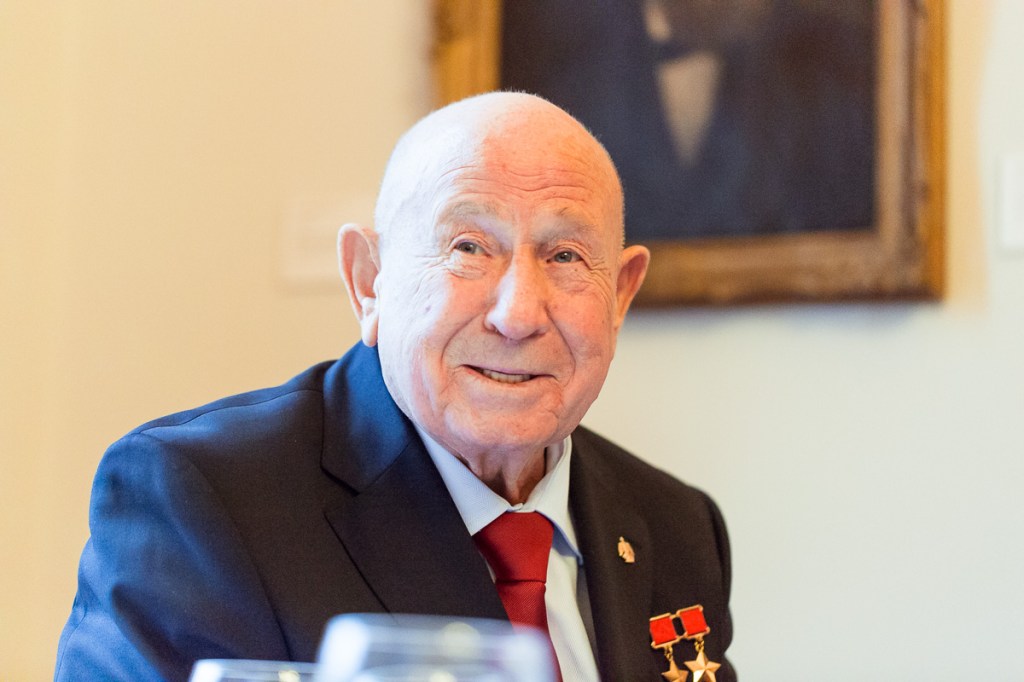
Alexei Leonov — the first human to walk in open space — recently embarked on a special three-day visit to London.
On day one, he met with children at the Science Museum, sharing insights into what it takes to become a cosmonaut. The second day saw him participate in the launch of the Starmus conference, a prestigious summer event dedicated to popularising science. The programme will feature luminaries such as theoretical physicist Stephen Hawking, Queen’s guitarist and astrophysicist Brian May, and evolutionary biologist Richard Dawkins — welcoming scientists and students alike.
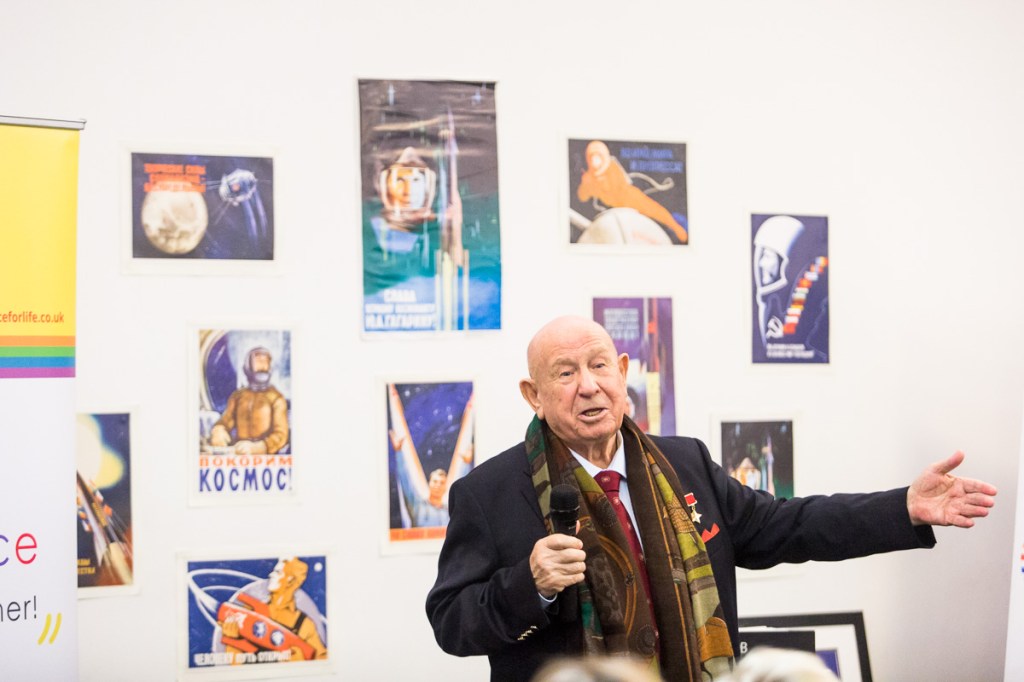
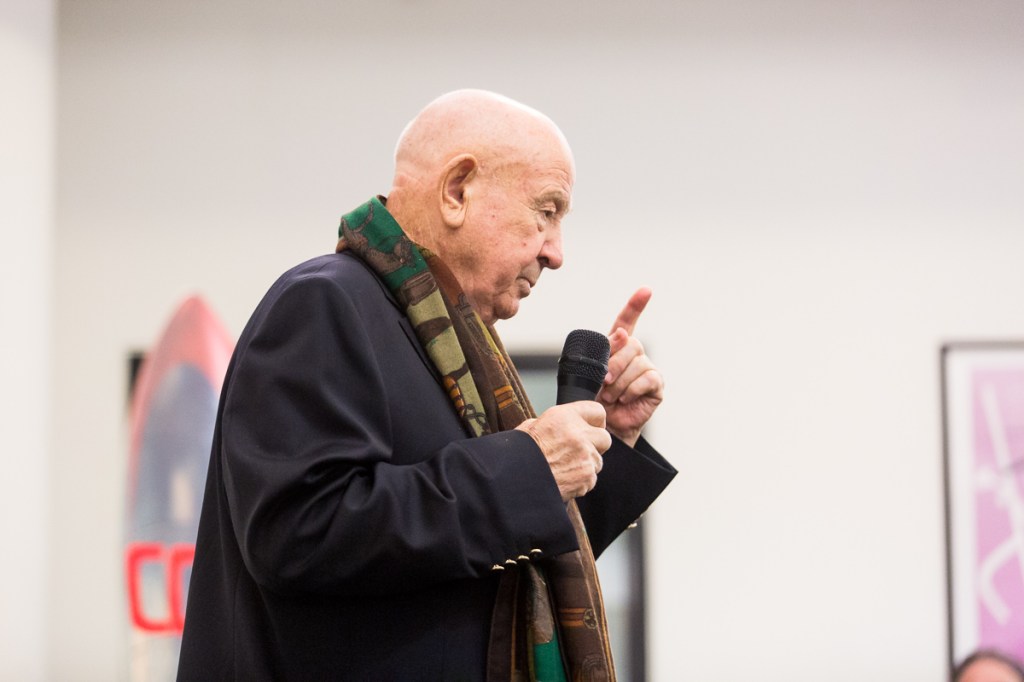
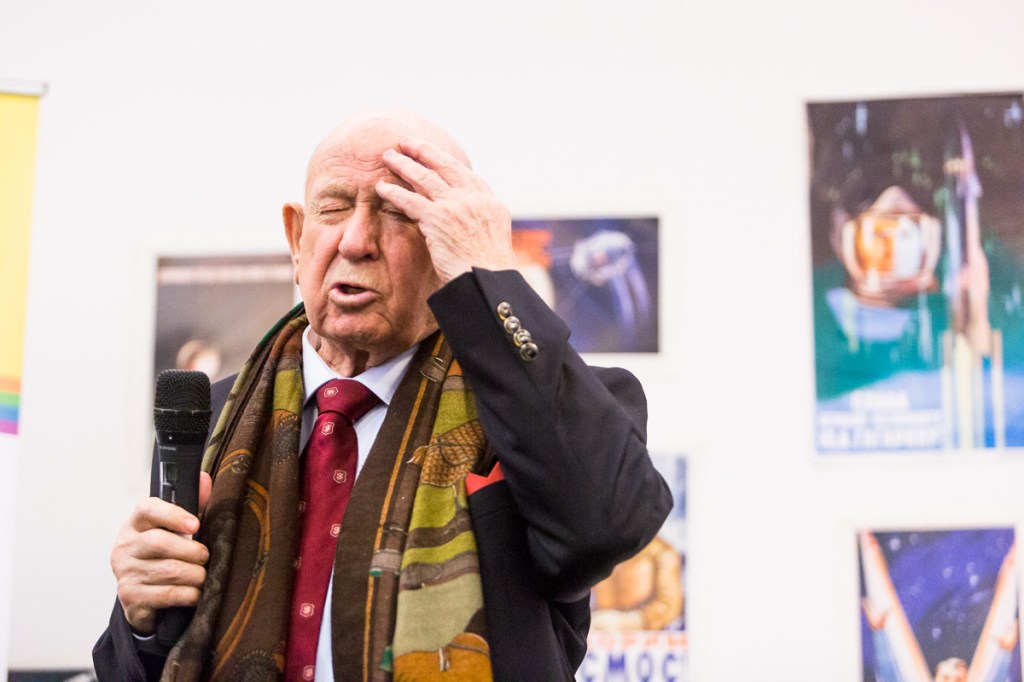
On the final day, Leonov visited Waterstones Piccadilly, where he spoke about his historic 1965 spacewalk and took part in a charity auction supporting Chance for Life, a foundation helping children in need of surgery.
Between these engagements, we had the opportunity to speak with Leonov about the present and future of Russian space exploration, a field in which he remains actively involved. We chose not to ask about his first spacewalk, knowing the audience at Waterstones would have their chance. What we didn’t expect was how captivating a conversationalist Alexei Arkhipovich is — lively, witty, humble, and thoughtful, never flaunting his experience, knowledge, age, or unique pioneer status, nor his talent as an artist.
Kristina Moskalenko: Alexei Arkhipovich, on December 15, British astronaut Tim Peake launched from Baikonur to the ISS. Do you know him personally?
Alexei Leonov: Yes, I saw him just two weeks ago in Star City when I was seeing off this crew: Tim Peake, NASA astronaut Tim Kopra, and Yuri Malenchenko — my former student. Yuri is very determined and strong-willed. This is his sixth flight. On the very day of launch, they manually docked with the station, with Yuri as the commander of the control system. The ISS weighs 400 tons, has a volume of 1,000 cubic meters, and 30 solar panels covering one and a half hectares — worth about $33 billion. Yuri commands this complex. If he makes a mistake, you won’t come back to Earth! The responsibility is enormous. And the training is extreme — you must give everything, abandoning all human weaknesses. Anyone who doesn’t commit fully doesn’t make it. Tim Peake’s program is very tough, approved by both the UK government and Roscosmos.
Kristina Moskalenko: Can a cosmonaut really prepare for all possible emergencies on the ISS? Is that realistic?
Alexei Leonov: It’s impossible to anticipate every situation. For example, when we were preparing for our spacewalk, a drone spacecraft had an accident, and the decision was made to convert our ship into a drone and build a new one for us. The chief designer, the brilliant mathematician Mstislav Keldysh, gently told us this to not upset us. We argued that we knew our ship from blueprints and training and were technically ready to fly. We didn’t say Americans would fly first — that would be unserious. I told him we had practiced about 3,000 emergency scenarios (actually about 500). Keldysh replied: “If you know 3,000, the flight will have the 3,001st, but you won’t be afraid because you’re prepared.” However, in flight, seven emergencies happened that were not in any manual!
Kristina Moskalenko: Does this mean the training was incomplete?
Alexei Leonov: One training program covers crew responses to emergencies. The examiners give totally unexpected emergencies during tests. The problem isn’t knowing scenarios, but the order and timing of events. If we failed one question, we wouldn’t fly. We only got grades 4 and 5 — 5 is rare, usually 4. If 4, we had to fix the gap. The actual emergencies in flight were new because the ship was new and unique — a very “temperamental” ship. But we were prepared.
Kristina Moskalenko: You chaired the State Commission for crew readiness for 20 years. How do you assess current astronauts like Tim Peake and Helen Sharman?
Alexei Leonov: I know them well. Helen Sharman is very strong — trained on centrifuges and in pressure chambers, no questions about her readiness. That’s why they said Tim Peake is ready — he knows everything needed and has the flight commander, Yuri Malenchenko, with six flights. Their statement is well founded.
Kristina Moskalenko: Is it true that despite all your preparation, all the emergencies you faced during your March 18–19, 1965 space mission were completely new and unexpected?
Alexei Leonov: Absolutely. We encountered unexpected oxygen toxicity issues linked to partial oxygen pressure. Similar problems happened during tests with Valentin Bondarenko in 1961, who tragically died in an oxygen-rich environment. During our flight, oxygen levels dangerously rose to 320, then 400, and up to 430 units—essentially a ticking time bomb. We fought this for seven hours by reducing pressure and temperature, but nothing helped. Eventually, oxygen intoxication caused us to fall asleep. Then a valve malfunctioned, raising the cabin pressure, likely causing the hatch to seal tightly due to metal expansion, trapping us inside with toxic oxygen levels.
Kristina Moskalenko: It sounds like a movie plot!
Alexei Leonov: Exactly — that incident inspired Hollywood. We reported our status to Earth, but communication blackouts lasted 45 minutes, putting us in a “radio shadow.” We switched to longwave transmitters, re-establishing contact over Antarctica. At one point, our spacecraft’s engine failed to separate from the service module, causing us to spin uncontrollably like dumbbells for 10 minutes before separation succeeded.
Kristina Moskalenko: Seven serious emergencies in 26 hours — incredible! Were none of these covered in your training manuals?
Alexei Leonov: None at all. We had to improvise solutions ourselves. If we had panicked, I wouldn’t be here today.
Kristina Moskalenko: How does your cosmonaut training compare to today’s preparation?
Alexei Leonov: Basic training remains similar: education, technical skills, and medical-biological conditioning. However, nowadays all crew members train for extravehicular activity (spacewalks) and survival courses in extreme environments like the Arctic, taiga, deserts, mountains, and seas. Earlier, only designated spacewalkers trained for extravehicular missions.
Kristina Moskalenko: Modern Russian space programs face criticism over rocket failures, like the Proton-M in 2013. How fair is this criticism?
Alexei Leonov: No technology is 100% reliable — even bicycles break down. Out of 3000 launches, two failures is quite low. Early American rockets exploded often too, but that didn’t stop progress. Achieving 999 out of 1000 reliability is excellent. The Proton failure was caused by a human error—a wrong engine part installed—not systemic collapse.
Kristina Moskalenko: Our audience at Waterstones is eager for more. We’ll continue sharing your remarkable story as the first person to walk in space!

Alexei Leonov’s Lecture at Waterstones Piccadilly: What It Felt Like to Be in Open Space
Below is a summary of the lecture given by Alexei Leonov, organized by the charitable foundation Chance for Life, held at Waterstones Piccadilly.
What Did You Feel When You Were in Open Space?
When I first stepped out of the spacecraft, I don’t really remember what I felt, but I heard Levitan’s radio announcement: “Attention, attention, a man has exited the spacecraft and is floating freely in space.” My first thought was, “Who is that?” I never expected things to happen so fast.
How Did the Flight Unfold?
About eight minutes into the spacewalk, I felt something was wrong — I was floating inside my suit. I thought, “If I report this to Earth, they will bombard me with questions.” So I decided not to report anything. Silently, I halved the pressure in my suit, knowing I was entering a risky nitrogen boiling zone, which could be fatal. But I had no choice. Lowering the pressure allowed me to control the suit, but I couldn’t re-enter the spacecraft feet-first as we trained. Instead, I had to enter head-first. The hatch was only 1.2 meters wide, but my suit was 1.9 meters! I somehow folded myself to fit inside. My heart rate rose to over 150, and sweat burned my eyes. Once inside, I opened my helmet — and couldn’t see anything. Then one crisis followed another.
First, oxygen levels rose dangerously. We fought for seven hours before falling asleep due to oxygen intoxication. How we survived, I don’t know. The engines worked well, no sparks from the collectors. When we regained consciousness, the spacecraft was spinning at 20 degrees per second, with sunlight from all three windows blinding us. This lasted almost a full day.
What Happened on Landing?
When we prepared to land, the engine failed to separate. We were on the far side of the Earth, with no way to ask for advice. We went into another orbit and switched to longwave radio. Over Africa, we reported choosing a landing site in the Arctic. I told the commander Pavel Belyayev, “We’re about to knock the stars down.”
We landed in the taiga. The hatch was stuck, pressed shut by pressure. Pavel jumped out into the snow, and I followed. We looked like two heads sticking out of the spacecraft. We needed to act. We set up the radio but couldn’t reach anyone; it was silent. Night temperatures dropped to minus 25 Celsius. We had sweat soaking our suits up to our knees and were freezing. We removed the suits, wrung out our clothes, and wrapped ourselves in nine layers of foil insulation. Then, tied ourselves with straps. Imagine: night, taiga, and two sausages by the spacecraft.
Eventually, a 9 km runway was cut nearby, and a 600-liter kettle was dropped there. Rescuers skied in, built a fire, warmed water, and the three of us—spacecraft, kettle, and two naked men. The next morning, we skied 9 km straight to the cosmodrome.
Were You Reprimanded Afterwards?
Yes, I was asked why I didn’t report the pressure drop and why I made the decision myself. I explained: “I had 30 minutes to live. If I’d reported it, they would have formed a commission, decided, reported… and I would have been dead by then. No one could help me there. So I made the decision.” Sergey Korolev supported me, saying I was right. Over 26 hours, I lost six kilograms. It was terrible.
How Alexei Leonov Was Sent on His Historic Spaceflight
When I was preparing for the flight, I met with Sergey Korolev, the legendary chief designer of the Soviet space program. He gave me a simple but daunting instruction: “No one has ever been there before. We won’t tell you anything. When you come back, you’ll tell us everything. Just be careful and work like a miner. And if you want, read something by Tsiolkovsky.” I took his advice and read Tsiolkovsky’s novel Beyond the Earth. It was fascinating how precisely this rural schoolteacher described spacecraft design and the sensations of being in open space.
There’s a curious detail: Korolev was against having women at the cosmodrome. Yet just before launch, as we were leaving the workshop, a woman appeared — the director of the State Scientific Film Studio. We immediately thought, “This means good luck, but also some trouble!” Indeed, we faced a series of system failures during descent. She even wondered aloud, “Why did I come here?” — showing the superstitions of the time.
Another superstition: if a woman carrying buckets of water walks by, it’s a sign of good luck. When I later became a commander and the crew changed, I made it a ritual. As soon as the crew left the hotel, I would find a girl with yokes and buckets to walk ahead. People would say, “We’ll be lucky — buckets full!” These small psychological rituals help, especially since astronauts head into the unknown, sometimes away for six months or more. It’s tough.
One of my colleagues, Tim — an English astronaut — went through cosmonaut training, test pilot school, Apache helicopter combat missions, survival instructor courses, and even studied philology. He left the army to join the astronaut corps and passed an intense selection. You can see how driven and focused he is — a truly whole person.
What Else Is Interesting About Tsiolkovsky?
I recently found a little-known note by Tsiolkovsky that not many people know about. Yuri Gagarin was born in 1934, and in 1935 Tsiolkovsky wrote a memo titled “How I See the Man Who Will Be Trusted to Pilot the First Spaceship.” He described the ideal cosmonaut as:
“This must be a Russian man, a Soviet man, definitely a fighter pilot. With an open face, big blue eyes, a smile, and a heart full of courage and bravery.”
This document was discovered only a couple of years ago — Korolev himself didn’t know about it. It’s an absolutely perfect portrait of Yuri Gagarin.
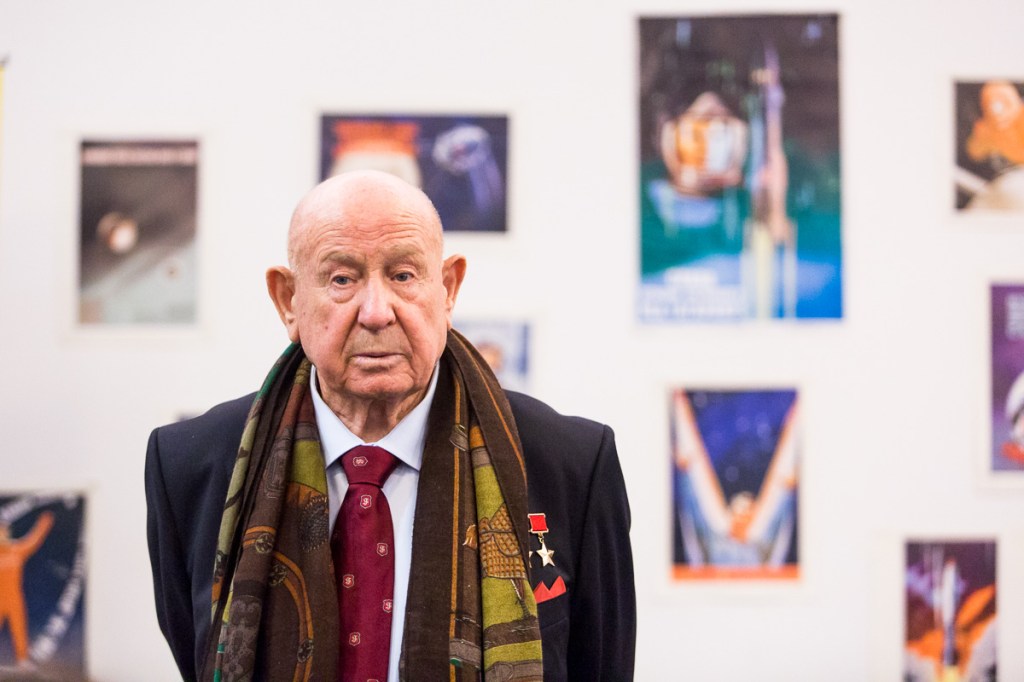
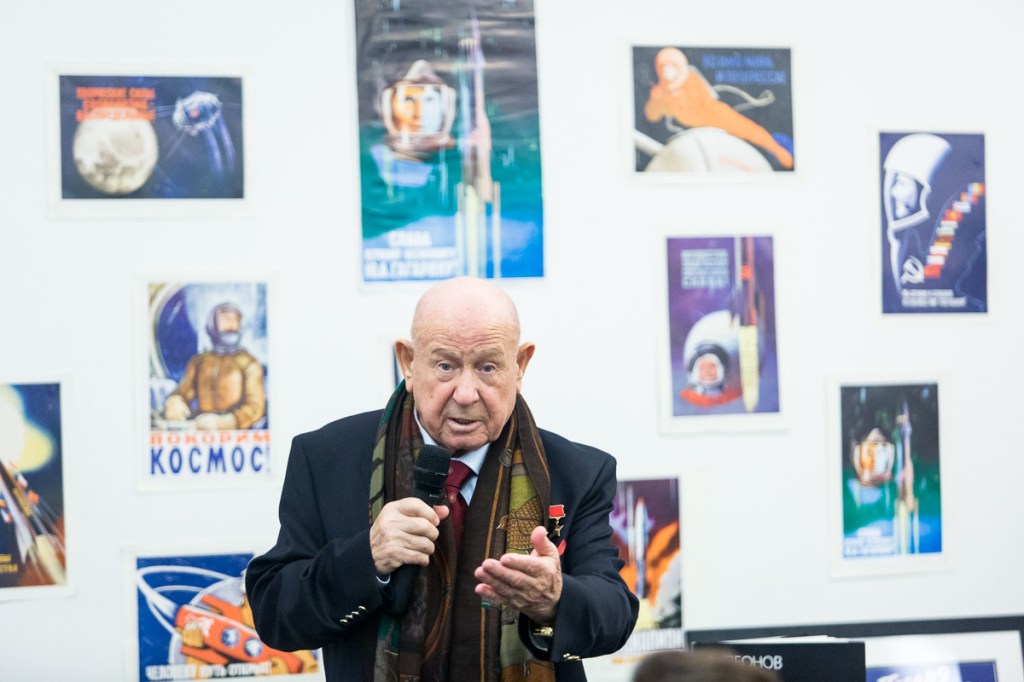
The Exhibition Cosmonauts: Birth of the Space Age at London’s Science Museum
Honestly, the exhibition is better than the ones I’ve seen in Moscow! I don’t know how they managed to bring exhibits that even our compatriots have never seen. It includes an actual lunar lander, which only specialists have ever laid eyes on. It’s housed at the Moscow Aviation Institute where students study its design.
If you haven’t visited the exhibition yet, you should! It starts with a simple truth — the first Earth satellite and its famous “beep-beep” signal. Older generations will remember this iconic sound that announced a new era for humanity.
The exhibition then showcases the entire Soviet space program: Voskhod, Vostok, Soyuz, the Soyuz-Apollo mission, and elements from the International Space Station. I was invited to consult on the exhibition during setup. Talking with the museum director, I thought, “This will never work. These are government-owned artifacts, unique pieces. There will be problems with sanctions and restrictions.” But when I saw the exhibition, I realized we must bow to the team that made it. It represents our country better than we ever knew! Every mission documented, and the lunar lander that many doubted ever existed — it does.
Did Americans Really Land on the Moon?
Yes, they did. During the Moon missions, only two countries didn’t closely follow the flights: the USSR and China. However, the Soviet Union was actively preparing its own lunar program. There was a party- and government-approved plan to orbit the Moon, after which a crew would be selected to land on it. Oleg Makarov was part of the first crew to orbit the Moon. We launched spacecraft, but after Sergey Korolev’s untimely death, new leadership deemed the lunar landing too risky. Meanwhile, six unmanned spacecraft successfully orbited the Moon.
It’s somewhat shameful that we had a real chance to orbit the Moon six months earlier than the Americans, but couldn’t land due to repeated malfunctions and Korolev’s passing. Eventually, the program was canceled. I watched the launches of Apollo 8, Apollo 10, and Apollo 11 at the Long-Distance Space Communications Center on Komsomolsky Prospekt. We witnessed the historic Moon landing live.
Why Did the American Flag Appear to Wave on the Moon?
A common question is why the American flag seemed to flutter. The flag was reinforced with special nylon threads, rolled up tightly, and placed in a protective cover. When unfolded, the flag’s movement was simply residual deformation, creating the illusion of wind—though there is no atmosphere on the Moon. Even filmmaker Stanley Kubrick talked about this.
Kubrick’s wife once said in an interview that he worked extensively on making a Hollywood film about the American Moon landing. This fueled conspiracy theories claiming the Moon landing was a movie staged in Hollywood. In reality, there are three surviving Apollo spacecraft: one in the Smithsonian Museum, one in Hollywood, and one that I flew on—making me a living witness to the truth. Kubrick shot some studio footage to complement the mission for viewers: the spacecraft standing still, the hatch opening, Neil Armstrong stepping out—because no one was there to film on the Moon itself. This is where the idea of a “fake” Moon landing came from.
Apollo 11’s Secret Reconnaissance
Before landing, Apollo 11 actually flew 100 meters above the lunar surface and filmed the entire landing route — something not widely known. Neil Armstrong used this detailed map during his descent.
The Moon Landing and International Relations
Whenever international relations sour, Moon landing conspiracy theories resurface. Yet in space, we always find ways to communicate and cooperate. It’s ironic that on Earth—where stakes are far higher—we struggle to find common ground.
Originally published: https://angliya.com/publication/poprobuy-oshibis-na-zemlyu-ne-verneshsya/
 Articles on film, luxury lifestyle, culture and tech
Leave a comment