By Kristina Moskalenko
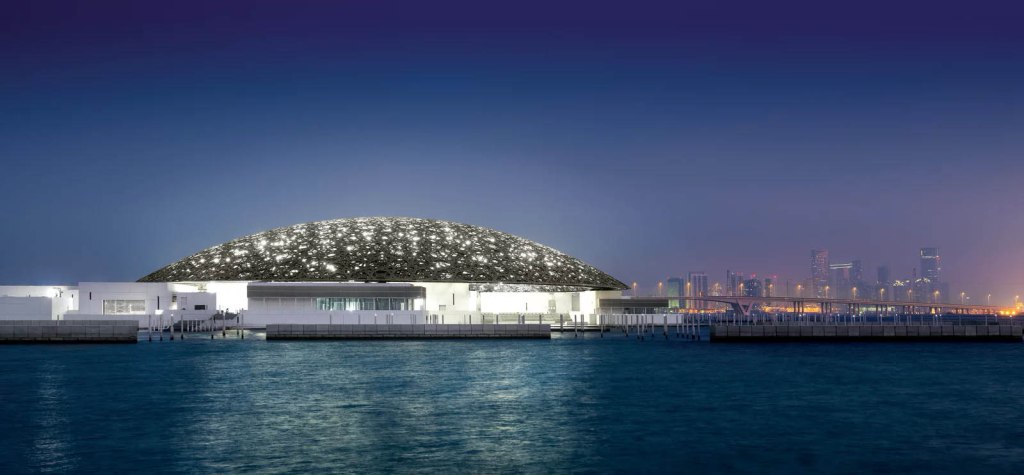
A museum where it rains? Or perhaps: a museum where it rains light? Or even crazier: a museum like Atlantis rising from the water? How about a museum-quarter instead of a single building? Or a museum-quarter overshadowed by a flying saucer?
All these concepts are embodied in the new Louvre, which opened in Abu Dhabi on November 11, 2017. Our correspondent Kristina Moskalenko managed to catch two birds with one stone: not only to take a private tour in Louvre Abu Dhabi, but also to speak with the architect Hala Wardé, who brought this ambitious project to life, in Paris.

April in Paris—sunny, yet still crisp with frost. The contrast makes the Louvre Abu Dhabi project, built in the scorching desert, appear even more striking. The project was developed here in Hala Wardé’s Paris studio in partnership with the renowned The Ateliers Jean Nouvel. Hala began her career under Jean, whom she studied with at The École spéciale d’architecture in Paris. Their professional partnership lasted 25 years, until Hala opened her own studio in 2008.
Among the duo’s notable projects is the shopping center opposite St. Paul’s Cathedral in London, One New Change (2010). Hala Wardé Studio’s independent projects include the BeMA contemporary art museum in Beirut. Hala began work on the desert Louvre a decade ago—which brings us to the first question.
Kristina Moskalenko: Hala, did you ever imagine you would one day build a Louvre?
Hala Warde: As a child, I loved building sandcastles on the beaches of Beirut, where I grew up. Those were my first architectural creations, preserved only in memory. I excelled in mathematics and the sciences at school, so studying architecture came naturally. At the time, war was raging in Beirut, so I moved to Paris. Of course, I never imagined I would work on a Louvre! It’s important to note that when Jean and I began this project ten years ago, we knew we were tasked with designing a world-class art museum as part of a major cultural development in Abu Dhabi—the Saadiyat Island Culture District. Yet for the first six months, we had no idea it would actually be the Louvre. A very pleasant surprise.
KM: Do you think the client didn’t want to stifle your creativity by attaching such a famous name as the Louvre?
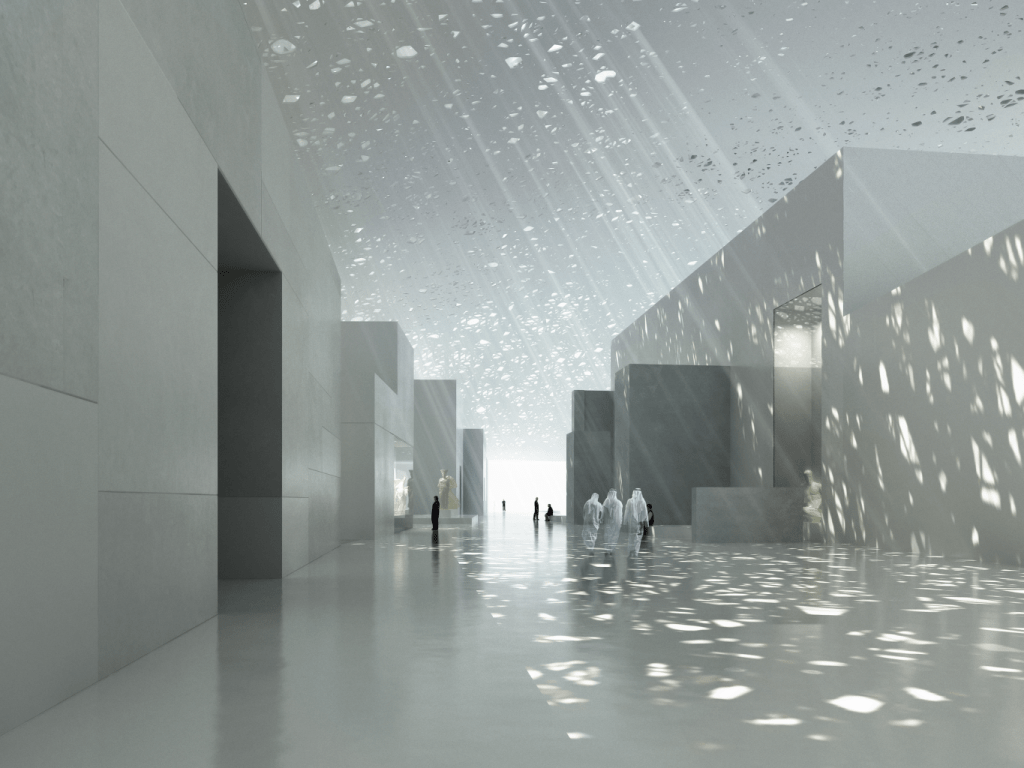
Hala Warde: That I don’t know, but I can tell you that it all started long before with a sketch on a napkin: Jean drew it on the train from Paris to London. The sketch showed a completely new concept for a museum: a series of separate buildings forming an open-air district, rather than a single structure where galleries and rooms are sealed off like in a tin can or a vault. We had been developing this concept for a long time, and Louvre Abu Dhabi project finally allowed us to bring it to life.
KM: It sounds a bit like some sort of shopping mall trying to mimic an old Italian town, can you tell me more to change that impression?
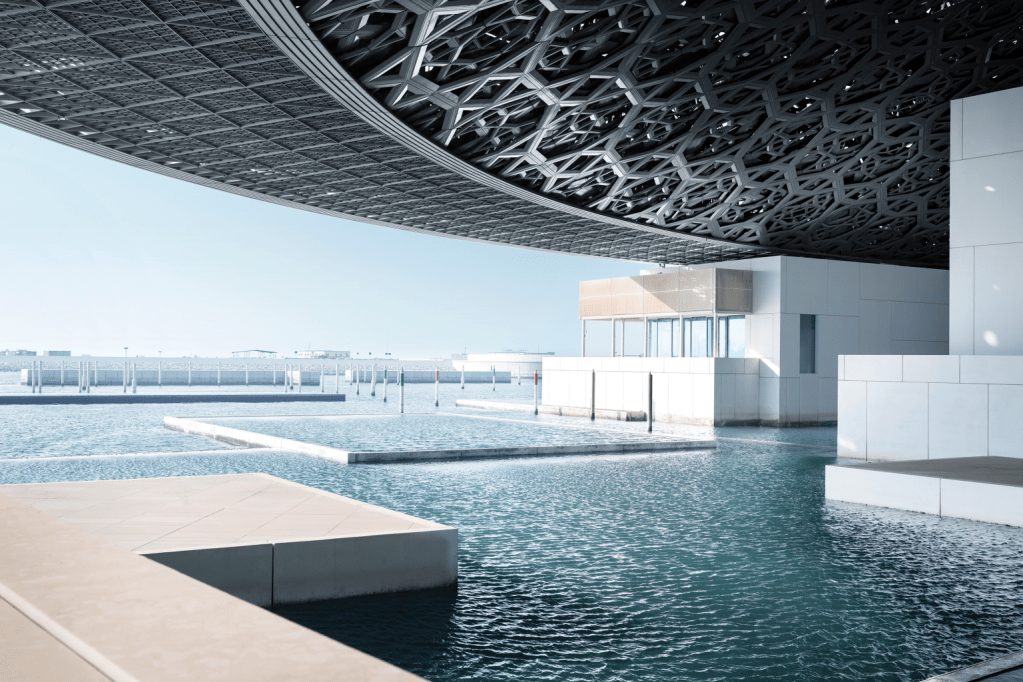
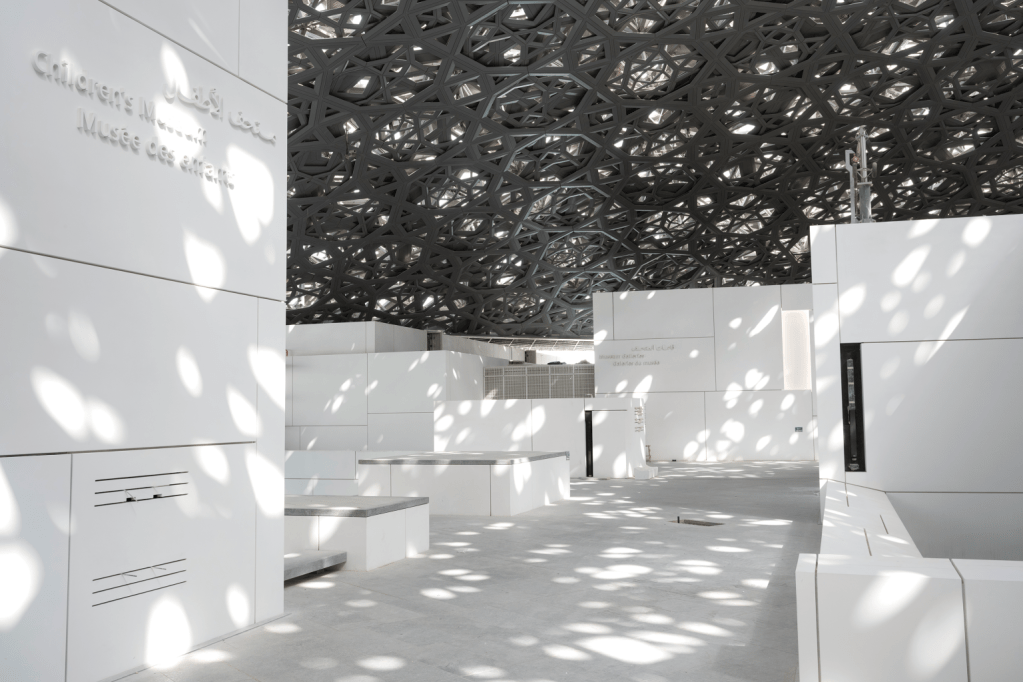
Hala Warde: We don’t aim to replicate, but to integrate architecture into the historical and cultural context of the place. The idea is to create a small district that feels like a historic settlement that has always existed here in Abu Dhabi. We call it “reversed archaeology”—as if you discovered a lost city rising from the water, rather than digging deep for it. It looks like visitors move from building to building, but in reality, they’re moving from gallery to gallery, because all these buildings are interconnected by the dome.
KM: Where did the dome come from, the one hovering like a flying saucer over the city, straight out of a Hollywood film?
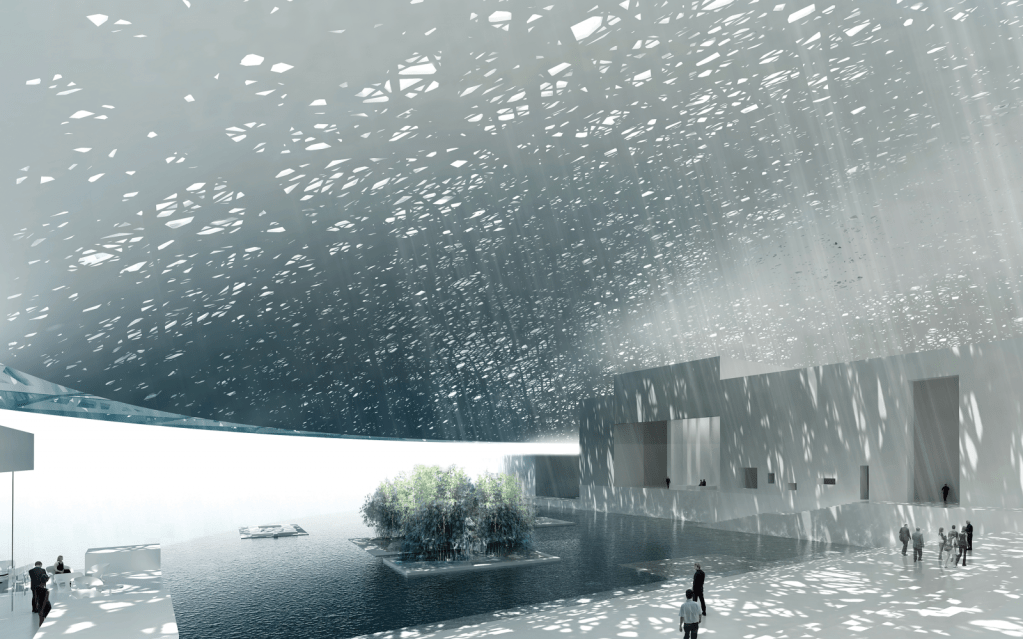
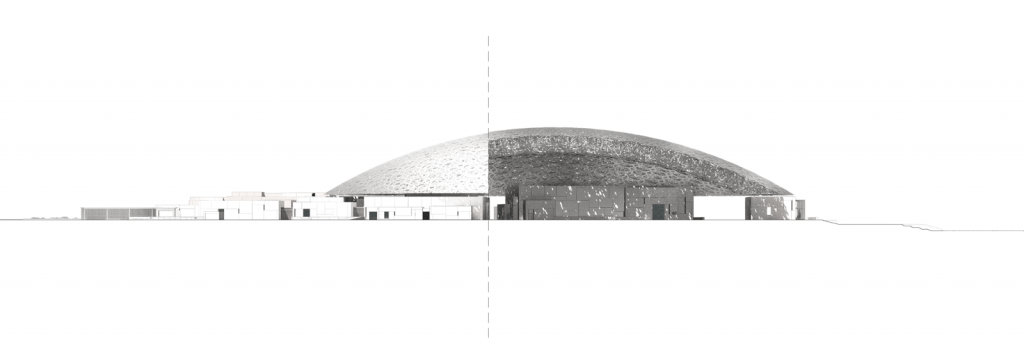
Hala Warde: The climate in Abu Dhabi is a unique mix of sand, wind, water, sun, and shade. We wanted to experiment with different states of the environment surrounding the visitor. There’s no need to stay in the shade all the time! If someone wants to step into the sunlight—please. Twenty percent of the dome simply covers water, reflecting sunlight. In other words, visitors can choose shade or sun, be near water or away from it, feel a gentle breeze or none at all—different experiences call for different atmospheres, all under one roof. Or rather—dome.
KM: So the dome serves not only a practical purpose, but also a symbolic one?
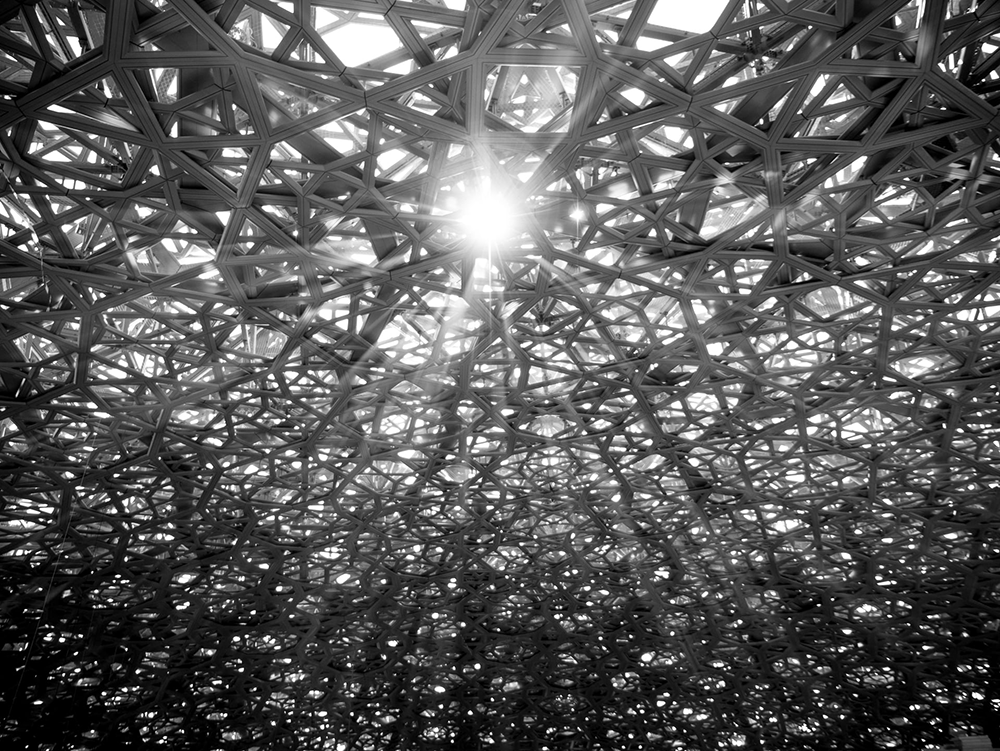
Hala Warde: On one hand, it is a quintessential symbol of Arab architecture. On the other, it is constructed from eight layers of metal, each etched with traditional patterns and layered atop one another. This creates a sense of density in the design while leaving spaces for light to filter through. Inside, the effect is never the same: the wind shifts, the water vibrates differently, sunlight moves across the perforations, and reflections change—connecting the architecture to the rhythms of nature. Light is the project’s core element because light symbolizes the cosmos. The dome’s perforation accounts for only 1.8%, yet the amount of light is extraordinary. At night, the effect continues—visitors can gaze at the stars!
KM: How did you preserve the Louvre’s identity in this new museum?
Hala Warde: When Jean Nouvel was invited to work on the project in 2006, it was referred to as a “classical museum,” not the “Louvre Abu Dhabi.” We only realised six months into the project that it would carry the Louvre name—a delightful surprise. The concept of the first universal museum in the Arab world arose from an intergovernmental agreement between the UAE and France, signed in 2007. Under this agreement, Louvre Abu Dhabi is, first, an independent museum licensed to use the Louvre name for 30 years—not a branch of the Paris Louvre. Second, its collection was curated from 17 French partner institutions, including 13 of France’s top museums, coordinated under Agence France-Muséums, which manages the museum’s collection, exhibitions, cultural, educational, and research programs in Abu Dhabi.
Thirdly, the ten-year agreement grants the right to exhibit works from the collections of all 13 partner museums in Abu Dhabi, not just the Louvre. Therefore, we were designing the project for the UAE, and the question of the Louvre’s identity was secondary. That said, if we focus on the Louvre itself: it is a world-class universal museum, housing art from all countries and eras. From this perspective, the Louvre Abu Dhabi perfectly preserves the essence of the Louvre in Paris.
KM: I once interviewed David Rockwell (Rockwell Group), and he shared that when he redesigned Union Square Cafe in New York, he measured lighting levels and the distance from chairs to the bar to maintain the identity of this beloved local spot…
Hala Warde: Of course, we didn’t go to such lengths, but there was one mystical architectural coincidence. When we, playing with architectural models on the computer, overlaid our 180-meter-diameter dome onto the Cour Carrée of the Louvre in Paris, we realised that the courtyard’s corners perfectly fit within the circle of our dome. In reality, the dome stands on four columns, and the courtyard’s dimensions of Louvre in Paris precisely match the distances between the columns of Louvre in Abu Dhabi. And yet, none of this was planned.
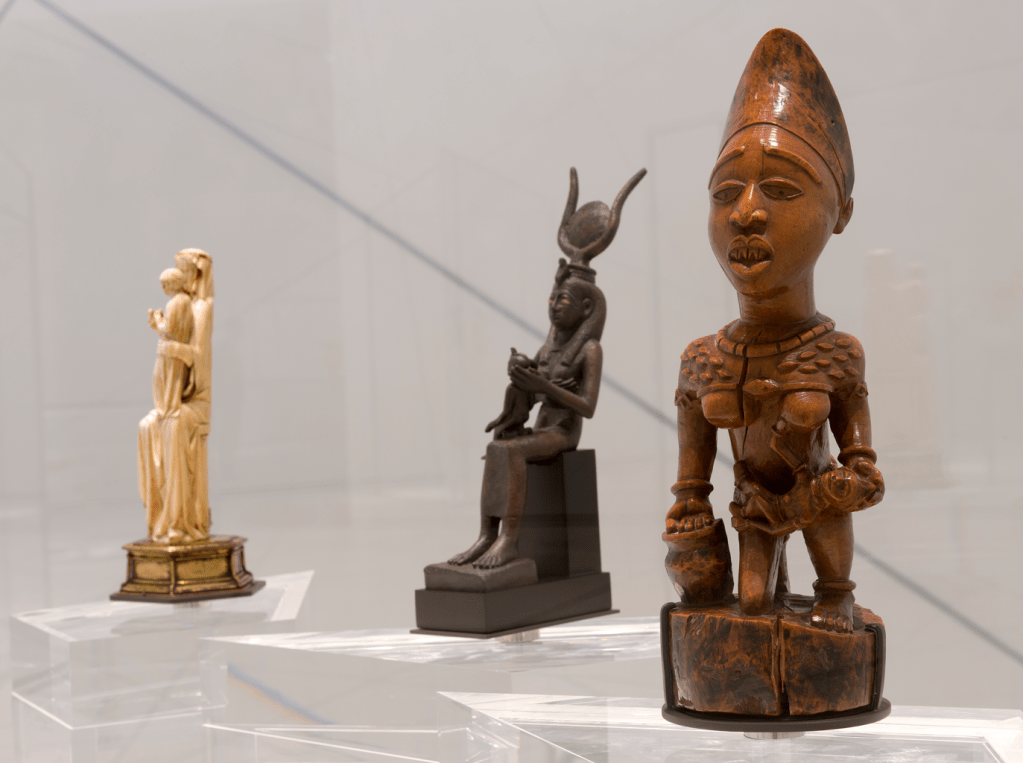
Also, let’s look at the palatial grandeur. Just like in the one in Paris, there is a sense that you are stepping into a palace. (The Paris Louvre used to be a palace.) Clearly, we didn’t measure the corridors of the Louvre, but we conveyed the palace-like feeling. It’s not so much about proportions as it is about a sense of nobility. For example, the floor in each gallery is made from different types of stone, chosen according to context; the ceilings are composed of patterned glass; and all the pedestals for the artworks are crafted from stone and bronze.
KM: So, is it a kind of palace of the arts, created with informational support from the French government and museums for the Muslim world?
Hala Warde: Interestingly, the fact that the museum is built in a Muslim country did not influence the selection of the collections. We created a universal art museum featuring exhibits from all over the world and from every era, from antiquity to the present day. What’s particularly remarkable is how the museum is organised. Usually, museums separate collections by region—one hall for Ancient Greek art, another for Ancient Egyptian art. Here, we structured the collections by era and theme.
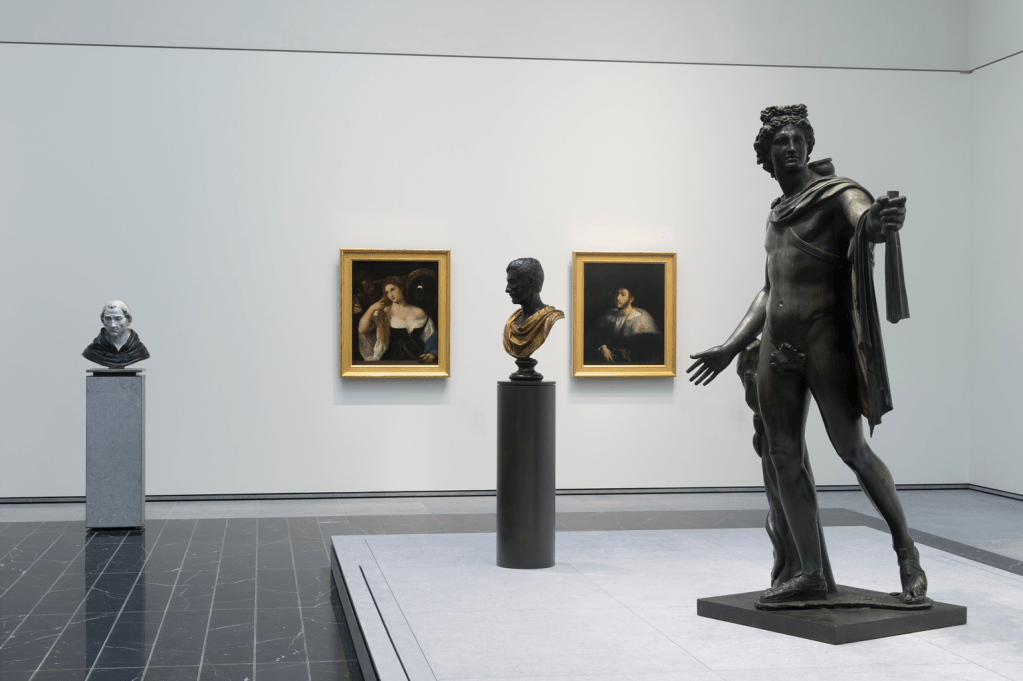
This means that as visitors move from antiquity to contemporary times, they experience different cultures that explored the same themes in parallel, albeit independently. Artifacts from around the world of the same period and on the same theme are displayed together in one gallery, offering a holistic view of global artistic expression. Seeing gold masks from China, South America, and the Middle East side by side is extraordinary! Or, how did the world’s civilisations reflect motherhood in the 16th century? Or explored the divine? Witnessing how cultures that may have had no contact with one another addressed these themes—standing face to face—is priceless.

KM: If you’ve applied such a global approach to the collections at Louvre Abu Dhabi, how does it translate to the building itself? Globally speaking, we’re facing climate change, and the region isn’t exactly the most climatically stable—floods, extreme heat, dust… And there’s a particular concern: Leonardo da Vinci’s Salvator Mundi is on display there, the most expensive artwork in history, which in November 2017—the same month the museum opened—sold at Christie’s for $450 million (including fees). What are your thoughts on this?
Hala Warde: We designed the building to last a century, accounting for all logically possible scenarios, so the museum shouldn’t flood. It currently rises four meters above sea level. We also installed breakwaters and other protective measures, ensuring not only the preservation of the building and its contents but also the most advanced logistics and infrastructure for transporting artworks. When we say the building is designed for 100 years, we mean that both the material quality and the engineering solutions have been carefully planned to maintain the structure in its original state for at least a century. That said, for many of the materials used, we don’t yet have long-term data, as they are entirely new.
KM: Hala, what was the most challenging part for you personally? Such a massive engineering project, involving countless specialists, all under the leadership of a woman. And it’s not that we’re used to thinking women should be fragile—it’s that there are still so few women in your profession. How did you manage it?
Hala Warde: I’ll start with the positive — I really appreciated the UAE government’s bold decision to embark on something so ambitious! And most importantly, they made it happen. The project, based on an intergovernmental agreement between France and the UAE, spanned ten years, which in itself was a challenge. The second difficult aspect was the dome.
Imagine this: the dome wasn’t built separately and then placed on top. It was constructed simultaneously with the museum because it’s incredibly heavy—its weight is comparable to the Eiffel Tower! And I had to plan the entire logistics, which took ten years. I visited the site every two weeks for three years.
And that’s not all—we weren’t just building a museum and a dome; we were building a museum that would stand on water, with the dome on top. So first, we constructed an artificial island, then removed the soil and filled the lagoons with water.
KM: And yet it looks so simple!
Hala Warde: That’s the art of it. Imagine my feelings when the dome was finished and I saw the first beam of light moving across the water through the perforations! There was another story with this dome: when it was ready and all the scaffolding was removed, it had to be lifted and secured on just four columns!
We lifted it overnight to inspect everything and remove the scaffolding from the columns, but no one in the world had ever done anything like this before, so we didn’t know if it would work while it was hanging there. It could have bent or tilted—I was anxious all night! This was a crucial moment in the construction. But the dome settled into place—everything went perfectly!
Figures:
- Total construction area — 97,000 m²
- Galleries — 8,600 m²
- Permanent exhibition — 6,400 m²
- Temporary exhibitions — 2,000 m²
- Auditorium — 420 m² / 250 seats
- Children’s area — 200 m²
Museum Buildings:
- Total: 55
- Permanent exhibitions: 26
Dome:
- 7,850 unique openings
- 8 layers of metal
- 180 m in diameter
- 565 m in circumference
- 85 super-large elements (weighing 50 t each)
- Highest point — 40 m above sea level
- Weight — 7,500 t (same as the Eiffel Tower)
- Dome perforation — only 1.8%
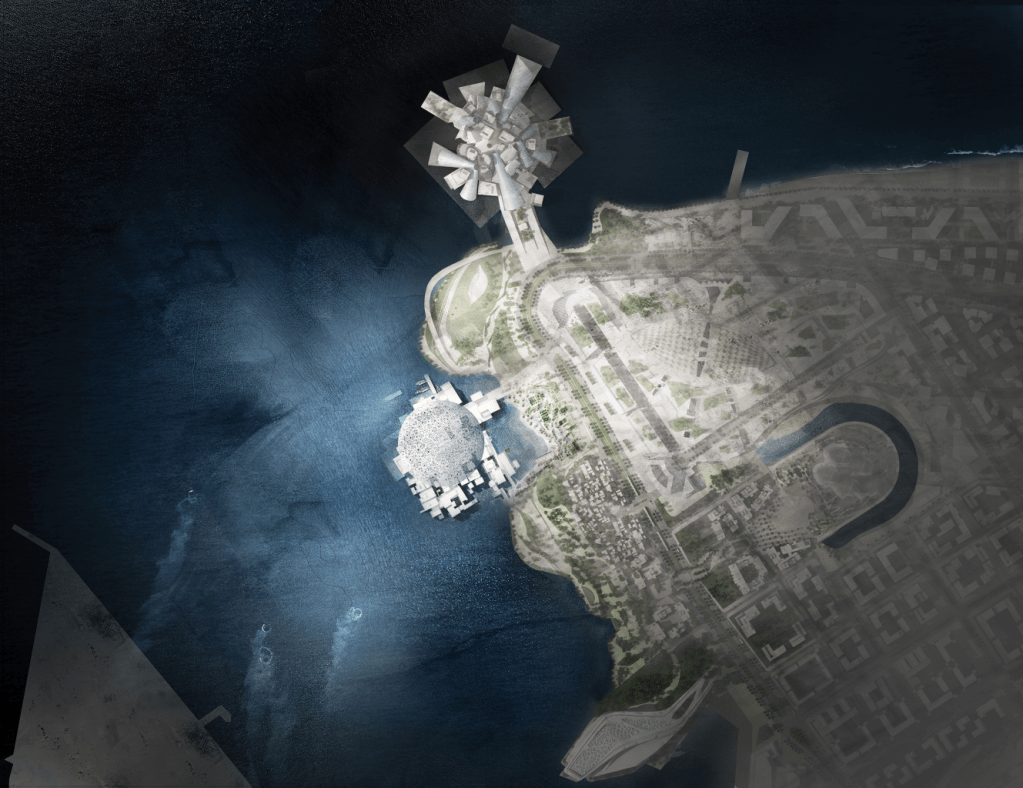
The Saadiyat Island Culture District includes:
- Sheikh Zayed National Museum
- Guggenheim Abu Dhabi Museum of Abstract Art, designed by Frank Gehry
- Louvre Abu Dhabi, designed by Jean Nouvel
- Performing Arts Center, designed by Zaha Hadid
- National Museum, designed by Norman Foster
- Maritime Museum, designed by Tadao Ando
- Manarat Al Saadiyat — cultural center
For comparison: Salvator Mundi — the painting by Leonardo da Vinci long considered lost. Its commissioner is generally believed to have been King Louis XII of France. In 2017, the work was purchased at Christie’s auction by the Crown Prince of Saudi Arabia for a record $450 million. It is now on display at the Louvre Abu Dhabi. The construction of the Louvre Abu Dhabi building is estimated at €600 million.
Originally Published: https://russianroulette.eu/quarter-atlantis-ufo-the-louvre
 Articles on film, luxury lifestyle, culture and tech
Leave a comment