
By Kristina Moskalenko
Every day, offers arrive in the mailbox, proposing to convert the historic Holland & Holland factory into sleek apartments or stylish studios. Every day, those same letters are tossed aside. Tradition reigns supreme here, and the ceaseless London drive to turn heritage buildings into hotels, luxury flats, or boutiques simply does not apply. Even in a city as eclectic and multicultural as London, a functioning gun factory in the heart of Kensal Green feels almost anachronistic — a living relic of craft, precision, and history.
Purpose-built for the creation of Holland & Holland shotguns, the factory opened its doors in 1895. Its siting is no accident: overlooking a centuries-old cemetery, it guarantees that nothing will ever block the vast windows or the sunlit interiors — essential for work that requires microscopic precision. Here, artisans engrave, stamp, turn, and polish with the care and patience of master jewellers.
The location resonates with deeper symbolism. Since 1835, the cemetery has been the final resting place of Joseph Manton, the inventor of the percussion ignition mechanism, whose innovations transformed the English hunting rifle and inspired generations to see hunting as a pursuit for all classes. That very same year, Harris Holland founded his eponymous business — a venture that would, six decades later, take root in this very factory. Light, craft, and history converge in a way that feels almost predestined.
Holland & Holland is not just a factory; it is a temple of English gunmaking, where the legacy of innovation, elegance, and meticulous craftsmanship endures, untouched by the frenzied march of London development.
From the outside, the royal gunmakers’ factory Holland & Holland is deceptively modest: four floors of brickwork, large sash windows, and a low, unassuming fence. This is precisely how a British factory crafting rifles for royalty should look — no crests, no gaudy signage, no ostentatious badges. Even the entrance offers no hint of the weaponry inside: no iron doors, no clanging locks, no fanfare.
Step inside, and the atmosphere immediately shifts. As is often the case with small, traditional British ateliers producing premium goods — whether cars, watches, or firearms — the factory feels unexpectedly domestic. Antique biscuit tins lurk in corners, faded 1990s pin-up posters adorn the walls, ficus plants perch on window sills, teacups cling to wooden tables, and benches are lined with tools that look more cobbler than gunsmith. The only thing missing is the aroma of freshly baked pies and a hostess in an apron.
Instead, a group of craftsmen labours with obsessive precision, carving shotgun barrels from solid blocks of steel. A silvery brick of metal is transformed into the rough shape of a medium-sized baseball bat, holes are drilled to form the barrel. It resembles 3D printing, not in layers but in reverse: material is painstakingly removed from a single block. Only here, it is done entirely by hand and on century-old machinery.
“Why don’t you cast the barrel, rather than carve it?” a visitor asks.
“For maximum strength,” comes the reply. “Once tempered in the furnace, this guarantees the barrel will not deform. This same technique has been in use for 135 years. In 1883, the venerable sporting magazine The Field — which still publishes today — organised a competition between ten different gunmakers. Holland & Holland triumphed in every category, a record that speaks for itself.”
Here, history, craft, and precision intersect — a living testament to a British tradition of gunmaking that has remained virtually unchanged for more than a century.

Many of the Holland & Holland shotgun and rifle models remain in production to this day. This is possible precisely because every component is made in-house — the company purchases no parts from third-party manufacturers. In an era dominated by globalisation, this singular commitment has allowed Holland & Holland to amass an extraordinary 51 patents, a record in the industry.
The factory is divided into five specialised departments: barrels, small mechanical components, woodwork, engraving, and finishing. Each craftsman is a master of a single discipline.
“I joined straight after school,” recalls one engraver. “I saw an apprenticeship ad in a sporting magazine, applied, and spent five years learning, then another five refining my skill. To make a gun worthy of a royal household, you need ten years. Not everyone can keep up with that pace,” he laughs. “But those who do develop their own signature. We can tell immediately which craftsman worked on a particular gun. We also record the names of every customer and every maker. Sometimes a son or grandson orders, and the work falls to the son or grandson of the original maker who worked with the father or grandfather. Today, about 40 people work at the factory. The youngest joined three months ago — he’s 18.”
From the barrels and rough metalwork, we move into the small parts department. At the entrance, resin-filled containers catch the eye. As a visitor from the Baltics, I naively assume it is amber for decoration. But, as Anna Akhmatova might have said, “If only you knew from what rubbish…”: the resin is heated, melted, and used to fill microscopic gaps between components. Every piece must fit perfectly.
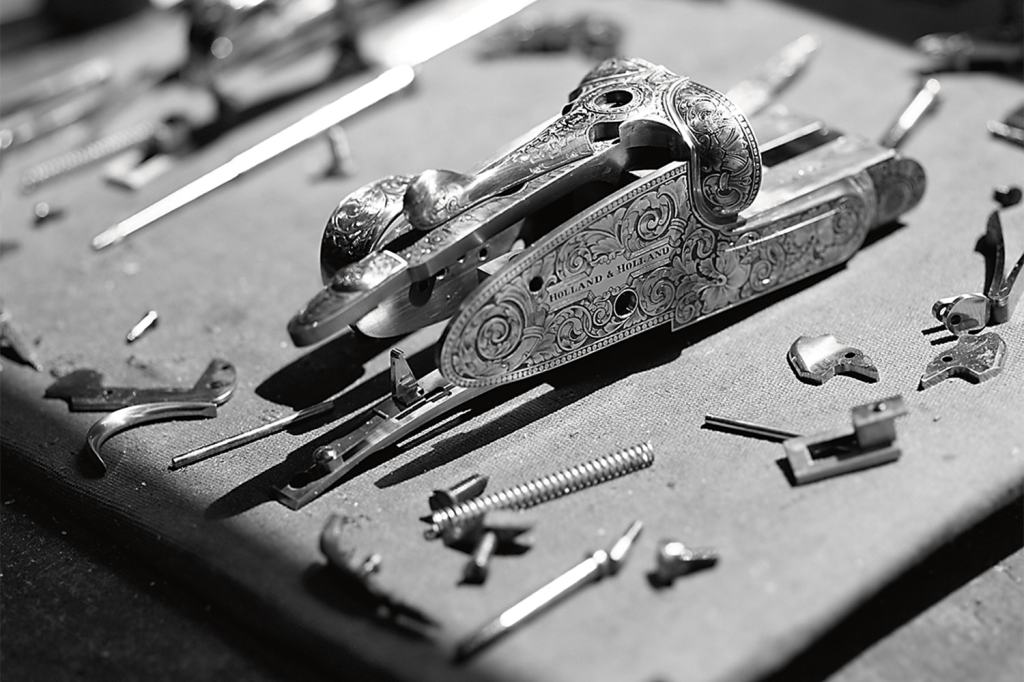
Perfection continues around the corner, behind a ficus, where benches are lined with dozens of types of files. “Each component is tailored to a single gun,” explains the craftsman. “The same part from the same model will not fit two different guns. All parts are numbered. Some take up to 30 hours to craft. Every pin is made by hand and fits only a specific hole. We have a special marking system so that any worker can disassemble and reassemble a gun flawlessly. When all parts are joined, there is no visible seam or gap — this level of precision can only be achieved by hand.”
Here, craft is ritual, patience is currency, and every gun is a testament to human skill at its most exacting.
Once the metalwork is complete, attention turns to the wood. Almost all of Holland & Holland’s timber comes from Turkish walnut, prized for its pronounced grain, natural colour variations, and the subtle traces of where roots or branches once grew.
“Eighty years ago, we used French walnut,” sighs one of the wood specialists. “It’s very stable — it doesn’t change over time — but it looks rather plain. Today, clients want something more intricate. That said, if someone orders two identical guns, we still select a simpler grain, because finding two visually identical pieces of Turkish walnut is impossible.”
The chosen timber is dried for two years in a climate-controlled room before being meticulously shaped to the customer’s specifications. Many shotguns are customised for left- or right-handed shooters, and there are even extreme cases — such as a client with only one eye. Every cut, every curve, is measured to achieve both aesthetic beauty and perfect ergonomic function.
The timber chosen by the client is first dried for two years in a climate-controlled room, before being meticulously shaped to their specifications. While most guns are customised for left- or right-handed shooters, there are occasionally extreme cases — such as a client with only one eye. Every detail is tailored to ensure both comfort and precision.
Once the wooden stock has been hollowed, carved, and perfectly fitted to the customer’s physical specifications, it undergoes a two-week “massage,” during which it is meticulously coated with linseed oil. “No lacquer,” explains a craftsman. “The stock’s shine comes entirely from the oil.”

The next stage begins at a shelf lined with dictionaries, marking the entrance to the engraving department. These reference books ensure that any client-selected inscriptions are flawless. While engraving is not permanent like a tattoo and can theoretically be redone, mistakes are highly undesirable: a simple pattern can take 120 hours, while an intricate design may require up to 600. Occasionally, the impossible is requested. “Once a client wanted his wife’s portrait engraved on a gun,” the craftsmen laugh. “By the time we were nearly finished, they had divorced. He didn’t realise that producing a custom Holland & Holland firearm takes two to three years.”
Among the more celebrated clients are Theodore Roosevelt and Prince Charles. In a touch of pop culture, a British Holland & Holland gun appeared in the 1978 television series Dallas, and during Queen Victoria’s reign, these firearms were coveted trophies among the maharajas of India.

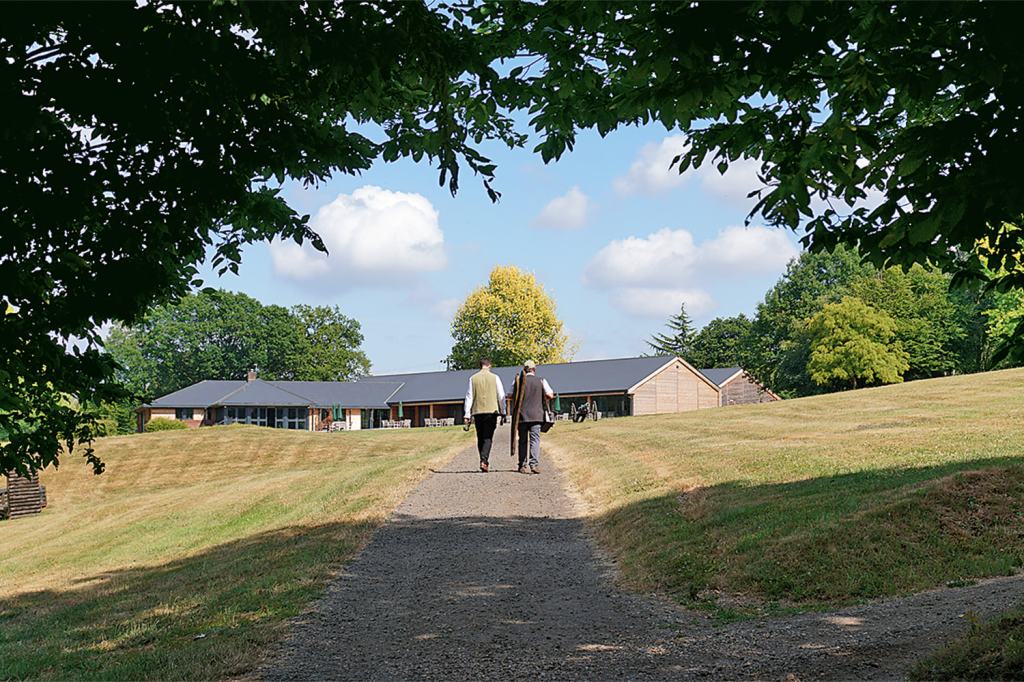
Today, in addition to bespoke firearms, the company offers a more accessible range of products, including specialist hunting clothing and shooting lessons, held at the Northwood estate.
Originally Published in: https://www.vedomosti.ru/kp/deluxe/article/2018/09/24/781770-tochno-v-tsel
 Articles on film, luxury lifestyle, culture and tech
Leave a comment