
By Kristina Moskalenko (Published in 2015)
The first six came here as spies. They didn’t know what they were getting into, but agreed to a secret job that required them to use all their previously acquired professional skills. They were placed in the back room of the Nokia factory in Farnborough, where not even the cleaners were allowed. This was how work on the prototype of the first Vertu phone began in the UK in 2000.
Since then, Vertu has established a dedicated factory in Hampshire – the heart of British aerospace manufacturing, surrounded by Rolls-Royce and McLaren plants. “This location is a sign that we’re not moving to China,” jokes Vertu CEO Massimiliano Pogliani, demonstrating how to attach anti-static straps to shoes, designed to protect phone components from electricity as we enter the workshop.
We are already wearing the anti-static blue coats. Vertu’s main manufacturing hall is a copy of Nokia’s reception in Helsinki: 50 shades of white, a sea of light through a glass roof, minimalism. The only difference is that at Vertu, you are greeted by a massive display behind which phones are assembled by hand. “Every Vertu phone in the world has come out from behind this glass,” explains Massimiliano, opening the door “behind the glass.”
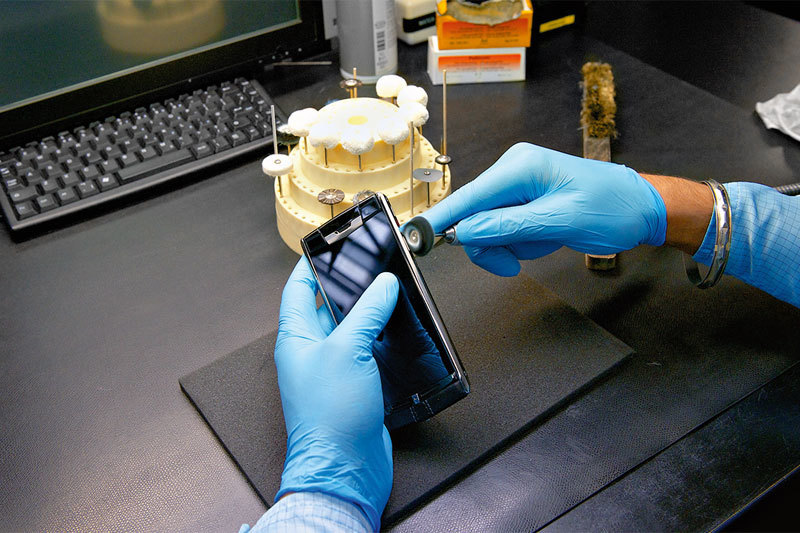
First, we step into the testing laboratory. Here, centrifuges, ovens, presses, and other tools are tightly arranged to “stress-test” Vertu phones. “When you spend this kind of money on a phone,” says Massimiliano Pogliani, “you naturally don’t want anything to go wrong, whether you’re in Antarctica, a desert, or the Amazon jungle. That’s why we constantly look for weak points in new models, which are tested under extreme conditions.”
If a vulnerability is found, an engineer immediately consults the design team. A minor flaw is even welcome, as it provides an opportunity to collaborate. The team might move to the neighboring lab—say, with material developers—and brainstorm a solution together. Everything is resolved on-site because all links in the chain—from design to production and distribution—are housed under one roof, eliminating the need for calls or miles of emails. “We never use machines for what can be done by hand,” explains Matthew, the staff training manager.

Interestingly, this old-school, hands-on approach perfectly complements the revolutionary technologies Vertu develops. Take, for example, the sapphire crystal covering the Vertu screen. “Sapphire is the second hardest material in the world,” says Pogliani, approaching a window in a small, isolated room where two technicians in gloves and masks peer through microscopes. “Sapphire is used for luxury watch dials, and the technology to grow sapphire crystals for watches has long been established.”
The crystals are grown in cylindrical forms and sliced into rings. But when Vertu began using sapphire for phone screens, much larger crystals were needed—something that had never been done before. Vertu’s team developed a method to grow a 69.25-carat sapphire crystal, despite widespread doubt that it could be achieved. Each crystal takes up to two weeks to grow, with cutting and polishing requiring up to 16 weeks, as only diamonds can scratch sapphire. The effort pays off: the screen can only be scratched with a diamond.
The finished sapphire glass is affixed to the liquid crystal display in a fully isolated room. “Not a single speck of dust can get between these two layers, or the screen is defective,” explains Massimiliano Pogliani. “Workers inspect the glass under a microscope, and the door is protected by an air curtain that blows away dust. The air in the room is refreshed every ten minutes—an ideal environment for anyone with allergies.”
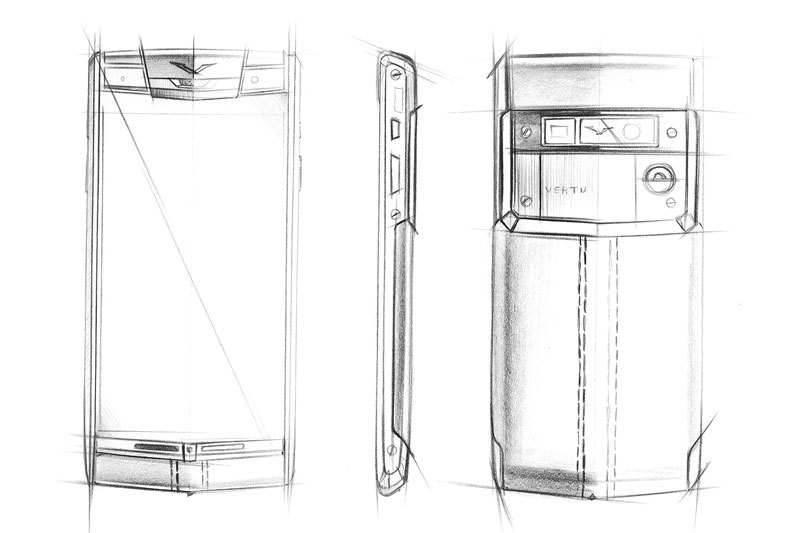
Once the screen is ready, it is placed on a tray alongside an average of 287 additional components. These trays, each containing the full set of parts for a particular model, are delivered to the hand-assembly hall on mobile carts, “hot and ready,” as if they were pastries. A team of 65 artisans takes over, each handling a tray to begin assembly. At Vertu, every worker is more than a link in a chain—they are an independent craftsman. Each artisan knows how to assemble any model, works deliberately with a focus on quality, has a personal workstation adorned with family photos, and most importantly, signs every phone they assemble.
“Now we’ll meet a historical figure,” Pogliani continues. “This is Wendy Beaven. She assembled her first Vertu over ten years ago. That phone ended up in China, and without understanding the artisan’s signature concept, counterfeiters reproduced phones—all bearing Wendy’s signature.” Wendy laughs: “They called them ‘Wendy Beaven phones.’ My husband even gave me one for my birthday.” Amanda, another artisan, scans each finished phone and tray, noting, “I sign six times before the designers select the final signature, which is then laser-engraved on the phone before packaging. I don’t personally sign the phones, but I ensure each tray and every finished device bears my mark in the system.”
Depending on the model, assembly can take anywhere from 30 minutes to four hours. All Vertu craftsmen undergo a six-month training course, during which Neil, a veteran of ten years at Vertu, assesses their manual skills. Consequently, the hiring process itself can take up to six months.
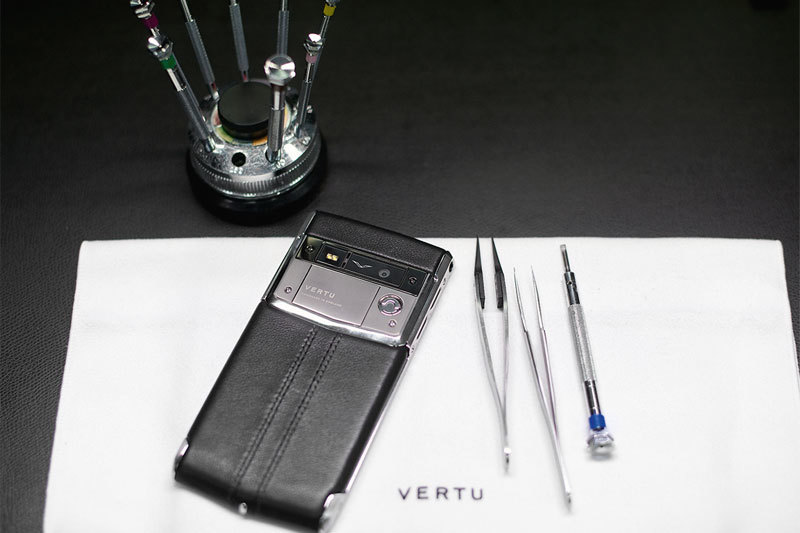
“Everyone you see here today are veterans compared to me. They joined before 2008,” Massimiliano Pogliani explains as he approaches a table of tools so tiny they could shoe a flea. “This is Donna. Almost her entire family works at Vertu.” Donna laughs, saying that Vertu runs in their blood, and immediately launches into a demonstration of the miniature screwdrivers: “Each screwdriver is automatic. It picks up the tiniest components like a vacuum. It also controls the torque when fastening parts. All Vertu phones have identical components fastened exactly the same way.”
Every Vertu phone undergoes two stages of testing. First, the device is checked internally: the screen, microphones, antennas, and over 300 electronic functions are tested, and the sound is tuned to the correct frequency. “From day one, our phones have delivered the best sound,” says Massimiliano. “The widest frequency range, Dolby surround technology, and perfectly tuned sound. Every phone.”
Next comes the hardware inspection, handled by Kay. Armed with lamps and a magnifying glass, she examines each phone for around eight minutes, checking for the slightest imperfections, unevenness, or scratches. “Vertu must not only perform flawlessly but also look impeccable,” Kay explains. “Look at this phone: it looks perfect and works perfectly. But press this button. Feel that? That’s our signature click, achieved with a ruby under the key. It’s not quite clean. This button will be pressed around two million times, and the click must remain perfect. That’s the beauty of handcrafting: if something isn’t perfect, it can be fixed by hand. I’ll scan this phone, see who assembled it, and within minutes it’ll go back for adjustment.”
“In practice, we have almost zero returns,” Pogliani adds. “Kay and her team inspect around 130 phones per day, and their work is flawless. Today, to achieve the highest quality in a phone, it must be assembled by a single artisan. The artisan’s signature on the phone is like signing a document. Design, premium materials, sound quality, concierge services—everything comes together through handcrafting. That’s what guarantees quality. Many clients, seeing the artisan’s name on their phone, want to meet the person who made it.”
Originally Published in: https://www.vedomosti.ru/lifestyle/articles/2015/03/12/ot-sapfirov-na-virost-do-komnati-pitok-kak-delayut-vertu
 Articles on film, luxury lifestyle, culture and tech
Leave a comment