
By Kristina Moskalenko
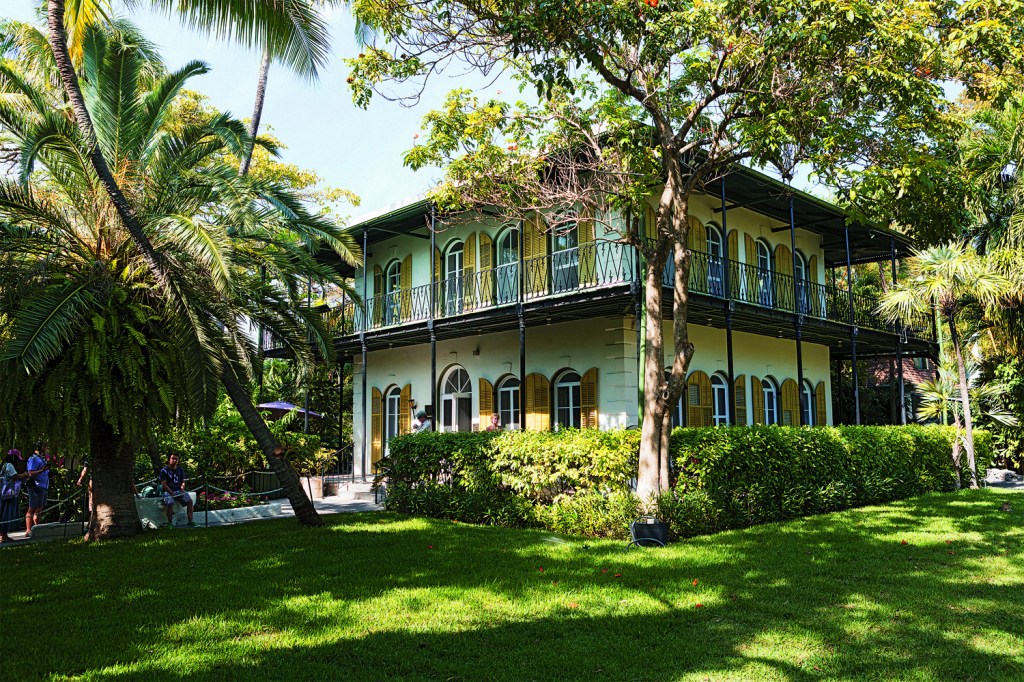
A portrait of Ernest Hemingway is instantly recognisable, a symbol of literary modernity with global resonance. But what did the writer himself choose to display on his walls, and what did the study look like where he produced his most celebrated works? The answers lie in his sun-filled, airy residence on Key West, Florida — a small island of just 26,000 residents, marking the southernmost point of the continental United States. Renowned for its literary heritage, vibrant arts and festival scene, tropical scenery, historic charm, and relaxed way of life, Key West remains a singular and iconic destination.
Locally, Hemingway is often recalled not solely as an individual but as part of a household that became legendary. Neighbours still speak of the HemingwayS with the ease reserved for familiar figures: “The Hemingways had the first swimming pool in the area,” “They washed in rainwater collected from a rooftop tank,” “The most fashionable house in town belonged to the Hemingways.” Much of this reputation stemmed from his second wife, Pauline Pfeiffer.
Hemingway met Pauline in Paris in 1926. An heiress to a wealthy American family of landowners and pharmaceutical and cosmetics manufacturers, she was the epitome of contemporary style: furs, a bobbed haircut, and Louiseboulanger suits. Professionally, she worked as a journalist and assistant editor in the fashion department, under Main Rousseau Bocher, who would go on to found the first American couture house in Paris.
In 1928, a year after their marriage, Hemingway travelled to Key West to collect a car being shipped from Cuba. When the delivery was delayed, he remained on the island to complete A Farewell to Arms. The southern latitude, the vestiges of its Spanish-pirate past twisted with the energetic rhythm of American life appealed to him so strongly that by 1930 the Hemingways had acquired a house there. Pauline discovered it at a foreclosure auction after unpaid taxes, and her wealthy uncle Gus helped fund the purchase.
Once, Key West was among the wealthiest cities in the United States — its earliest permanent residents made their fortunes salvaging shipwrecks and claiming part of the cargo. By the 1930s, however, locals referred to the town as “St-Tropez for the poor.” The house Hemingway would later purchase, designed in 1851 by architect Asa Tift, was in a sorry state. Asa’s family had succumbed to typhoid, and the house had stood empty for years. When Pauline Pfeiffer first opened its doors in 1931, plaster fell from the ceiling, prompting her to joke ever after that the house was cursed.

Undeterred, Pauline set about transforming the typical New Orleans–style home with a touch of Parisian chic. She had the ceiling fans, standard for the region, replaced with Venetian glass chandeliers. Furniture arrived from Paris: medieval Spanish leather chairs with sword pockets, “Blackamoor” porcelain statues holding trays for visiting cards, and other curiosities. The headboard in the Hemingways’ bedroom was fashioned from the gates of a Spanish monastery, and three antique birthing chairs were placed nearby — their function in the décor remains a mystery. The couple quickly employed a nanny, a cook, and a young woman to help with laundry. Hemingway selected the second floor of the former kitchen, built as a separate building for the heat and airing reasons, as the site for his study.

Before the advent of air conditioning, Key West residents built separate kitchen houses in their yards to prevent the heat of the hearth from warming already sweltering homes. The Hemingways, however, brought the kitchen back into the main house, converting the second floor of the former kitchen building into a study. It was here that Hemingway wrote To Have and Have Not, Green Hills of Africa, For Whom the Bell Tolls, and roughly 75 per cent of his short stories, including The Short Happy Life of Francis Macomber, The Snows of Kilimanjaro, and Death in the Afternoon. Access to the study was via a suspension bridge from the house’s veranda, allowing Hemingway to step almost directly from his bedroom into his workspace each morning. Evenings were spent fishing or at the legendary Sloppy Joe’s bar.
It was at this very bar, in 1936, that Hemingway met his future third wife, Martha Gellhorn, who arrived in a small black dress. Relatives of eyewitnesses claim she came to the island deliberately to meet him, and that the dress was far from accidental. Shortly after, the writer and Gellhorn travelled to Spain to cover the Civil War.
The island’s only swimming pool — the envy of neighbours — was the product of this domestic drama. Upon learning of her husband’s adventures, Pauline Pfeiffer didn’t do the revenge dress, but she did the revenge pool. The challenge lay in Key West’s limestone bedrock, which had to be blasted to create the basin for the pool that she ordered to built, while still legally married. Construction cost Hemingway $8,000, while the entire estate had been purchased for $20,000. Upon discovering the expense, Hemingway angrily tossed an American cent onto the pool’s tiles, declaring it his last — that his wife had ruined him. Ever the witty hostess, Pauline had the cent embedded in the cement. After Hemingway left for Cuba in 1939, she spent years entertaining guests by showing them the coin, joking that she was the only one of his wives to receive even a single cent from him.

Following Pauline’s death, the house was rented out, including to American military personnel who trained in the very pool. In the early 1960s, Bernice Dixon, owner of the nearby Beachcomber Jewelry Store, rented part of the property. In 1961 she purchased it outright with the intention of living there, only to find herself besieged by fans eager to see “where he spent his happiest and most productive years, and where fame found him.” In response, Dixon transformed the property into the private Hemingway Museum that continues to attract visitors today.
“She was fortunate, because the basement and attic were filled with Hemingway’s belongings,” told How to Spend It correspondent local Linda Mendez, who worked at the museum for 29 years. “We even have a letter from the writer’s son stating that the new owner could use the items as she wished. There’s furniture, photographs from fishing trips, war trophies, and mementoes from the African expedition, which, according to my sources, was funded by that same Uncle Gus. I’ve always been intrigued by a bottle sealed inside a metal cage with a lock, to stop the servants from drinking the alcohol. I’m not sure whether Hemingway was hiding it from the staff or from himself — or whether he was hiding it at all — but it was there in his house.”
Among the clutter, a broken Picasso cat figurine was discovered. When Bernice Dixon established the museum, she invited Hemingway’s first wife, Elizabeth Hadley Richardson, to visit. It was she who recounted that Hemingway had traded the cat for a box of hand grenades from Picasso, whom he had met through Gertrude Stein in Paris. Cats, it seems, are a central attraction at the Hemingway House. There are 56 of them, many with six or seven toes, all descendants of Hemingway’s original pair of polydactyl cats, Snowball and Snow White. The pair had been gifted to the writer by Captain Harold Stanley Dexter, following the maritime superstition that a six-toed cat brings good luck.
“We do not give away the kittens,” Linda sighs. “On one hand, U.S. law requires us to control the number of animals on the museum grounds; on the other, it would be selfish to breed Hemingway’s cats for sale, when countless unwanted animals can be found in any shelter.”
Another notable exhibit is a print of Joan Miró’s 1922 painting The Farm. “It was Hemingway’s first personal artwork,” says Linda. “He gave it to his first wife, Hadley, for her birthday. Later, he ‘borrowed’ it from her and never returned it. It now resides at the National Gallery of Art in Washington, donated by Hemingway’s last wife, Mary Welsh.”

In Key West, there is a curious sense of life’s full cycle on display: the island is as notable for its bars and houses of fleeting pleasures as it is for its cemeteries. And however glamorous Pauline Pfeiffer’s life might have been, Hemingway was never insulated from these local influences. For instance, he installed a urinal from a men’s restroom at the entrance to the garden.
“He was a regular at the local bar, Sloppy Joe’s,” smiles Linda Mendez. “In 1937, the bar relocated to a neighbouring street, and they placed various fixtures, including a men’s urinal, outside the door. Hemingway walked by, seized it, and said, ‘I’ve poured so much money into this that it belongs to me now,’ and carried it home to place in the garden — he called it his own swimming pool, apparently.”
It is well documented that Hemingway’s garden was once visited by titans of American literature, including John Dos Passos and Sinclair Lewis. Today, the museum attracts roughly 600 visitors a day, along with the writer’s grandchildren. The last island resident to have known Hemingway personally, the boxer Kermit Forbes, died in 2000; he had sparred almost daily with the writer in Hemingway’s backyard.
“Hemingway was certainly an interesting man, but I don’t think I would have liked him personally,” Linda laughs. “He could be arrogant and haughty. But, of course, it probably depended on his mood and intentions! I’m convinced that if we had met when I was twenty and a beauty, he would have been utterly charming.”
Originally Published in Vedomosti: https://www.vedomosti.ru/kp/article/2017/02/10/677005-dom-starini-hema
 Articles on film, luxury lifestyle, culture and tech
Leave a comment